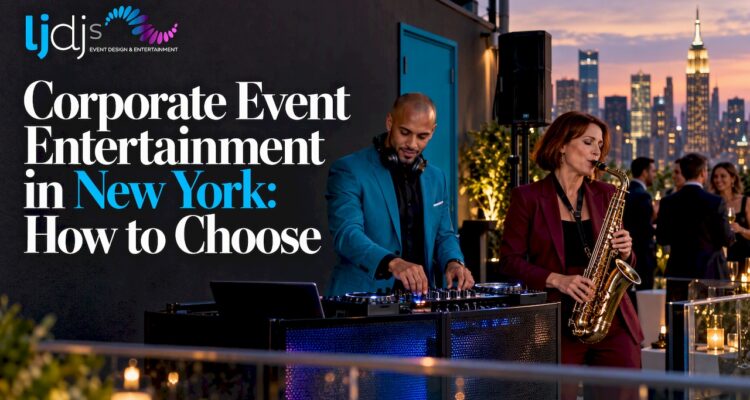
The best corporate event entertainment in New York is the kind built around your room, not around anyone’s personal taste. Start with the goal of the event, the age and professional mix of the guests and the flow of the schedule. Then pick a DJ and MC, a live band, specialty performers or a blend of them. Finally, confirm the sound, lighting, staging and permit details with the venue before anything is booked. This guide walks through each step.
TL;DR
- Choose entertainment for the whole room (age, profession, energy), not for what the planner likes. That is the most common planning error.
- A DJ with an MC is the most flexible base for a New York corporate event. Add live musicians, specialty acts or visual production when the goal calls for them.
- Budget for production and logistics (sound, lighting, staging, load-in), not only the performer’s fee.
- Get the timeline in writing, confirm it again the week of the event, and settle sound-system and volume limits with venue staff.
- Street events and parks have their own NYC permit rules. Check them before you promise amplified sound.
Table of Contents
- What counts as corporate event entertainment in New York
- Start with the goal and the room
- What a corporate DJ actually does
- DJ, live band, specialty acts or a mix
- Sound, lighting and staging: what to coordinate
- What to confirm before the event
- New York rules that can affect your plan
- How to budget for entertainment
- Perspective: why we build entertainment around the whole event
- Working with LJDJS
- A simple planning timeline
- FAQ
- Sources
What counts as corporate event entertainment in New York
The phrase covers more than a playlist. In New York, companies typically book some mix of these:
- A DJ and MC. Music for arrival, dinner and dancing, plus someone who runs announcements, toasts, award moments and transitions.
- Live musicians. Solo players, small ensembles or bands for cocktail hours, receptions and headline sets.
- Specialty acts. Performers who create a visual moment: dancers, interactive acts or featured entertainers.
- Production enhancements. LED video walls and screens, intelligent lighting, wireless uplighting, monogram or logo projection and special effects.
- Guest experiences. Photo booths, photography and videography, and crowd motivators that get a quiet room moving.
Most events use several of these at once. The skill is in sequencing them so the evening has a shape: welcome, content, meal, celebration. A planner who treats each as a separate vendor often ends up with sound that fights the lighting or a performer who runs into the speeches.
Start with the goal and the room
Before comparing acts, write down what the event is for. A product launch needs attention on a stage and a screen. A holiday party needs a dance floor. A client dinner needs conversation-friendly music that lifts later. An awards night needs precise cues.
Meetings Today’s guidance on aligning entertainment with an event’s mission says acts should support specific goals, match the energy of the schedule and suit the demographics of the audience. It also notes that the total cost should include the production and logistical fees that come with an act.
A useful exercise is to describe your guests in three lines:
- Who is in the room? Age ranges, seniority, and whether it is one team or several companies.
- What do they do all day? A room of lawyers after a long conference day wants something different from a sales team coming off a kickoff.
- What should they feel when they leave? Energized, appreciated, connected, impressed.
The same Meetings Today piece points to a common error: choosing acts by personal preference rather than by the makeup of the full room. If the person booking loves jazz and the guests are mostly under 35, the room will tell you quickly.
A quick audience check
| Room | What usually works | Watch for |
|---|---|---|
| Mixed ages, many cultures | DJ with a broad catalog, bilingual MC | Music that skews to one generation |
| Executive dinner | Low-key music through dinner, then a lift | Volume that blocks conversation |
| Large company party | DJ plus lighting and video, interactive moments | Dead time between program items |
| Conference evening reception | Live musicians or a DJ at a lower level | Setup that disrupts the venue’s schedule |
| Client appreciation night | A featured act plus a polished DJ set | Overpromising a show the room cannot see |
What a corporate DJ actually does
A corporate DJ is part music programmer, part host and part stage manager. The set list matters, but so do the quiet jobs: reading the energy, keeping transitions tight and making sure speeches start on cue with working microphones.
A good corporate set usually has these parts:
- Arrival and cocktail hour. Background music at a level that lets people talk.
- Program moments. Introductions, awards, a CEO’s remarks, a video. The DJ or MC cues them and covers any gaps.
- Dinner. Music that fills the room without competing with it.
- Dance or celebration block. Where the room’s makeup decides the music, and where an MC who can read people earns their fee.
Keeping guests engaged is mostly about pacing. Long stretches of unstructured time lose people, and so does a dance floor opening before the room is warm. An MC who announces the next moment, brings people toward the floor and keeps speeches short does more for engagement than any single gadget.
For a deeper look at how production and entertainment fit together for companies, see our overview of corporate event production and what it covers.
DJ, live band, specialty acts or a mix
There is no universal winner. Use the goal to decide.
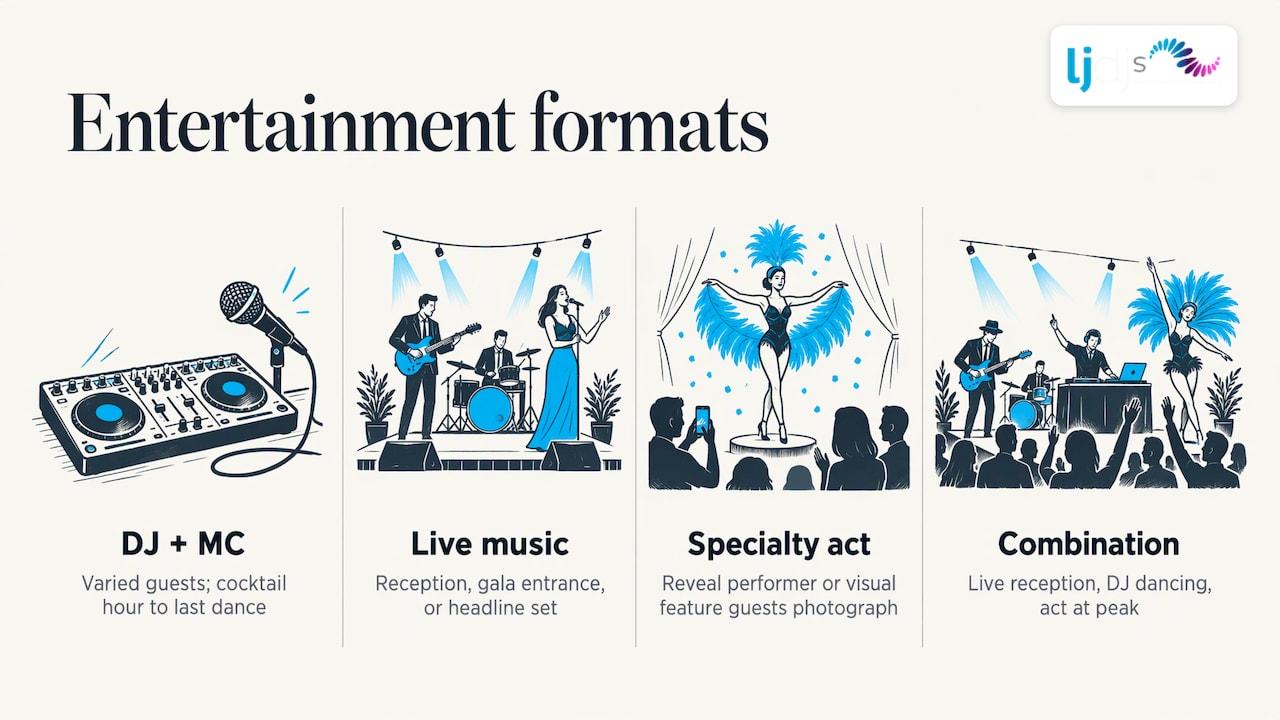
Choose a DJ and MC when the guest list is varied, the schedule has many program moments, or you need a wide range of music across a long evening. A DJ covers cocktail hour to last dance without a break.
Choose live musicians when you want atmosphere and presence: a reception, a gala entrance or a headline set. Bands need more stage space, power and sound-check time, so they work best when the venue can support them.
Choose specialty acts when you want a single memorable moment, such as a performer at a reveal or a visual feature that guests will photograph. Place them deliberately, because they work as punctuation, not as the whole evening.
Choose a combination when the event has distinct parts. A common pattern is live music during the reception, then a DJ and MC for dinner, program and dancing, with a specialty act at the peak. One team coordinating all of it avoids handoff problems between vendors.
If the event needs a polished focal point, a custom DJ booth can double as a design element. We build Piano DJ and Chandelier DJ booths for rooms where the entertainment should also look part of the design.
Sound, lighting and staging: what to coordinate
The technical details decide whether a good plan feels good in the room. Work through these with the venue and your entertainment team early.
- Power and load-in. Where equipment enters, which elevator, what time, and who signs for it. Manhattan buildings often have freight elevator windows, so ask early.
- Sound system. Whether to use the venue’s system or bring your own, and whether the two are compatible. Ask about volume limits too.
- Stage and DJ position. Sightlines to the program area, distance from the dance floor, and cable runs that do not cross guest paths.
- Lighting. Venue lighting levels during speeches versus dancing, and whether uplighting or intelligent lighting can be installed without affecting the space.
- Screens and visuals. LED walls and screens need rigging or floor space, content approved in advance, and a person responsible for cues.
- Microphones. The number needed for speakers, who has them, and a backup.
Food service timing also shapes the entertainment plan: courses, buffet lines and bar service all change when the room is ready for a dance block. Planning the meal and the music together is part of event catering logistics that corporate planners should settle early.
What to confirm before the event
A written plan prevents most day-of problems. A guide to running corporate events from a DJ’s perspective recommends that planners get the timeline in writing, confirm it with the coordinator the week of the event, coordinate setup and soundcheck with venue staff, ask about sound-system compatibility and volume limits and bring backup equipment.
Turn that into a checklist:
- A written run of show with start and end times for each segment.
- Load-in time, setup time, and sound-check time agreed with venue staff.
- Contact names and mobile numbers for the day: the planner, venue manager and lead entertainer.
- The pronunciation of names and titles that the MC will announce.
- A do-not-play list and a must-play list, if either applies.
- What happens if something fails: backup microphones, backup playback, and who decides.
- A final call or message the week of the event to reconfirm everything.
New York rules that can affect your plan
For most indoor events, the venue sets the rules: sound limits, load-in windows, insurance requirements and approved vendors. Ask for these in writing. For events outdoors, on streets or in parks, city permits come into play.
- Street events. The NYC Mayor’s Office of Citywide Event Coordination and Management says amplified sound requires an NYPD permit, and structures over 10 feet tall require a Department of Buildings permit.
- Sound devices. The NYPD’s sound-device application form states that permits may not be issued from 10 p.m. to 9 a.m. It sets tighter hours within 50 feet of residences, and it requires filing at the local precinct at least five days before the event, with listed exceptions. Check the current form before you rely on these details.
- Parks. NYC Parks requires permits for events with more than 20 attendees, with applications due at least 21 days ahead, according to the city’s permit portal.
Rules change, so confirm with the issuing agency for your date and location. If your venue is a rooftop, a terrace or a shared building, ask the property manager about their own amplified-sound policy as well.
How to budget for entertainment
The performer’s fee is only part of the total. Production items such as lighting, screens, staging, extra microphones, travel and load-in labor add up, and the Meetings Today guidance cited above reminds organizers to include those production and logistical costs when comparing options.
When you request quotes, ask each provider to itemize:
- Performance hours, including setup and breakdown time
- Equipment: sound, lighting, screens, booth
- Staff: DJ, MC, technicians, photographers
- Add-ons: effects, photo booths, specialty acts
- Anything the venue will charge separately
Quotes that bundle everything into one number are hard to compare. Quotes that itemize let you decide where to spend and where to save. For many companies, extending the program with a visual element, such as a video wall for sponsor messages or a logo projection, gives more value than adding another hour of music.
Perspective: why we build entertainment around the whole event
We have been producing celebrations for more than 20 years across New Jersey, New York and internationally. What we see again and again is that corporate guests remember how the evening felt, not the equipment list.
That is why we do not treat a DJ, lighting, video and photography as separate purchases. Our approach is to design the event around your company’s style and your guests’ culture, then build the entertainment to fit. Our team includes bilingual and international DJs and MCs, which matters in a New York room where guests often speak more than one language.
Our in-house enhancements let us keep everything under one plan: the Piano DJ Booth and Chandelier DJ Booth, LED video walls, intelligent and wireless lighting, monogram projection, photo booths, live musicians and specialty acts. One team means one timeline, one set of cues and fewer places for something to slip.
When a client tells us the goal, we work backward from it. A launch gets a stage moment and a screen. A party gets a dance floor that fills. Every detail should be there on purpose.
LJDJS
Working with LJDJS
If you want one team to handle the music, the MC, the lighting and the visuals for a New York or New Jersey corporate event, we can plan and run it with you. We tailor each event to your company’s style and your guests, and we can add production elements such as LED video walls, intelligent lighting, photo booths, photography and videography.
See our event production services and full list of enhancements, or contact us through our site to talk through your date, venue and goals.
A simple planning timeline
| When | What to do |
|---|---|
| Early planning | Set the goal, headcount, budget and venue. Describe the audience. |
| Venue stage | Get the venue’s sound, load-in, lighting and insurance rules in writing. |
| Booking | Request itemized quotes. Choose a base act, then add enhancements that serve the goal. |
| Permits (if outdoors) | Check NYPD, Buildings and Parks requirements and their lead times. |
| Several weeks out | Share the run of show, names, music preferences and content for screens. |
| The week of | Reconfirm the timeline, contacts, load-in and sound-check times. |
| Event day | Arrive for setup, sound-check, walk the room, brief the MC, then run the plan. |
FAQ
Should a corporate event in New York have a DJ or a live band?
A DJ and MC suits mixed audiences and busy programs, because one person covers music and announcements for the whole evening. A live band suits a headline moment or a reception where presence matters, but it needs more space and sound-check time. Many companies combine both.
How far ahead should I book corporate entertainment in New York?
Book as soon as your date and venue are set, because popular dates fill and production elements need planning. Outdoor or street events also need permit lead times, such as the five-day filing for NYPD sound devices and 21 days for NYC Parks permits. Confirm the current rules with the agency.
What should a corporate DJ and MC handle besides music?
They run announcements, cue speeches and videos, keep transitions tight and read the room to set the energy. A good one also coordinates with the venue team on sound and microphones, and works from a written timeline.
What does corporate entertainment include besides a DJ?
Companies often add live musicians, specialty acts, LED video walls, lighting, monogram or logo projection, photo booths and photography or videography. Choose add-ons by the event’s goal, so each one has a job to do.
Sources
- Choosing Entertainment: How to Align Your Event’s Mission, Vibe and Audience, Meetings Today
- How to DJ a Corporate Event: The Complete Guide, Songboard
- Street Events, NYC Mayor’s Office of Citywide Event Coordination and Management
- Sound Device Application, NYPD
- Special Events Permits, NYC Parks