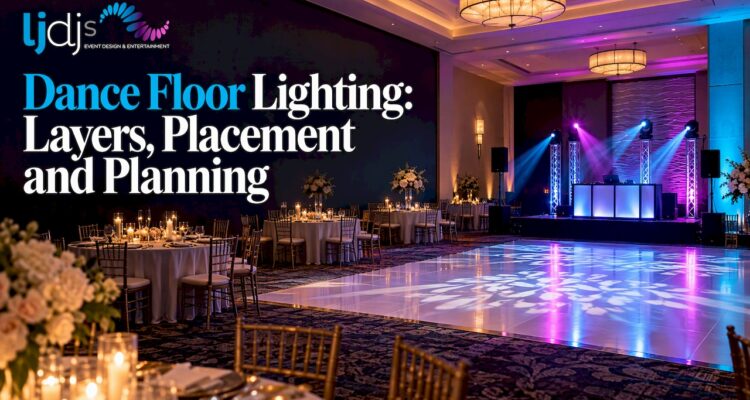
Good dance floor lighting is built in layers: a soft wash of color for fill, moving fixtures for motion, texture effects for sparkle, and a few accents for big moments. It runs from a controller or follows the music, and it works with the sound, the room and the photographer. Hung and programmed by the people who are also playing the music, it feels like part of the night rather than a rented extra. That is how we approach it at LJDJS, where lighting, DJ and MC work are designed together for weddings, corporate events and milestone celebrations across New Jersey, New York and beyond.
This guide explains what each type of fixture does, how many you need, how dance floor lighting differs from venue uplighting, how to keep it flattering in photos, and what to check before guests arrive.
TL;DR
- Think in four layers: fill (wash or uplights), motion (moving heads or scanners), texture (lasers, gobos, sparkle) and accents (strobes for peak moments).
- Dance floor lighting reacts to the music. Uplighting stays mostly static and shapes the mood of the room.
- For a mid-size floor, two to four LED moving-head or wash fixtures at roughly 8 to 10 feet are a common starting point.
- Keep bar and seating areas warmer and dimmer than the floor, and raise the lights for toasts and cake cutting so photos stay clean.
- Walk the room with every effect and the haze running, and confirm that every exit sign stays visible.
Table of Contents
- What dance floor lighting actually does
- The main types of dance floor lighting
- Build the floor in four layers
- How many fixtures and where to put them
- Dance floor lighting vs. uplighting
- Wedding dance floor lighting: when it is worth it
- Lighting and photography: keep it flattering
- Sound and lighting working together
- Safety checks before the doors open
- What a good lighting plan looks like on paper
- Lighting for corporate events and milestone parties
- Where LJDJS fits
- Our perspective
- FAQ
- Sources
What dance floor lighting actually does
A dance floor with no lighting plan usually has one of two problems: the room is lit like a dining hall and nobody wants to be the first one out there, or it is dark with a few dots swirling over the walls. Lighting tells guests where the party is. When the floor is brighter and more colorful than the surroundings, the space reads as the place to be.
The contrast between zones does the work. One venue guide suggests keeping bar and seating areas at a steady, warm 3000K with roughly 50 to 100 lux on dimmable fixtures, on a separate circuit from the dance floor. Guests then read bright as social and dim as dance. (Lux is a measure of how much light lands on a surface; 3000K is a warm, soft-white color temperature.)
That is why dance floor lighting is not a single product. It is a design for the whole room, and the dance area is the brightest, most dynamic part of it.
The main types of dance floor lighting
You will see a lot of names on quotes and rental lists. Here is what they mean in plain terms. The common categories include wash lighting, moving heads and scanners, uplights, and effects such as moonflowers, disco balls, lasers, strobes and beams.
Wash lighting
A wash fixture throws a wide, soft beam of color over a large area. Mobile DJs commonly use LED pars or bars for this, and wash lighting is described as the base of any light show. It is the layer that gives the floor its overall color, and it is the one most likely to show up in photos, so it is also the one to choose with care.
Moving heads and scanners
Moving heads are fixtures on a motorized yoke that sweep, pan and tilt, projecting beams and patterns across the floor and the ceiling. Manufacturers’ guides describe moving heads with up to 540° of pan and 260° of tilt, which is why a few fixtures can cover a lot of ground. Scanners do something similar with a mirror, sending beams in tight patterns.
Effects: disco balls, lasers, strobes and beams
These give the floor texture. Popular choices include strobes, disco balls, rotating sphere effects and laser beams. A disco ball is the old classic for a reason: it throws small points of light across guests, walls and ceiling and makes a room feel like it is moving.
Gobos and monograms
A gobo is a small stencil placed in front of a light so it projects a shape or pattern, such as a couple’s monogram on the dance floor. It is one of the most personal lighting choices at a wedding. We cover placement and planning in our guide to wedding gobo lighting and monograms.
Haze
Haze is a thin mist in the air that makes light beams visible. It is described as the single best multiplier for lasers and moving beams: without it, even expensive fixtures can look underwhelming. It also has a safety side, covered below.
Light-up floors
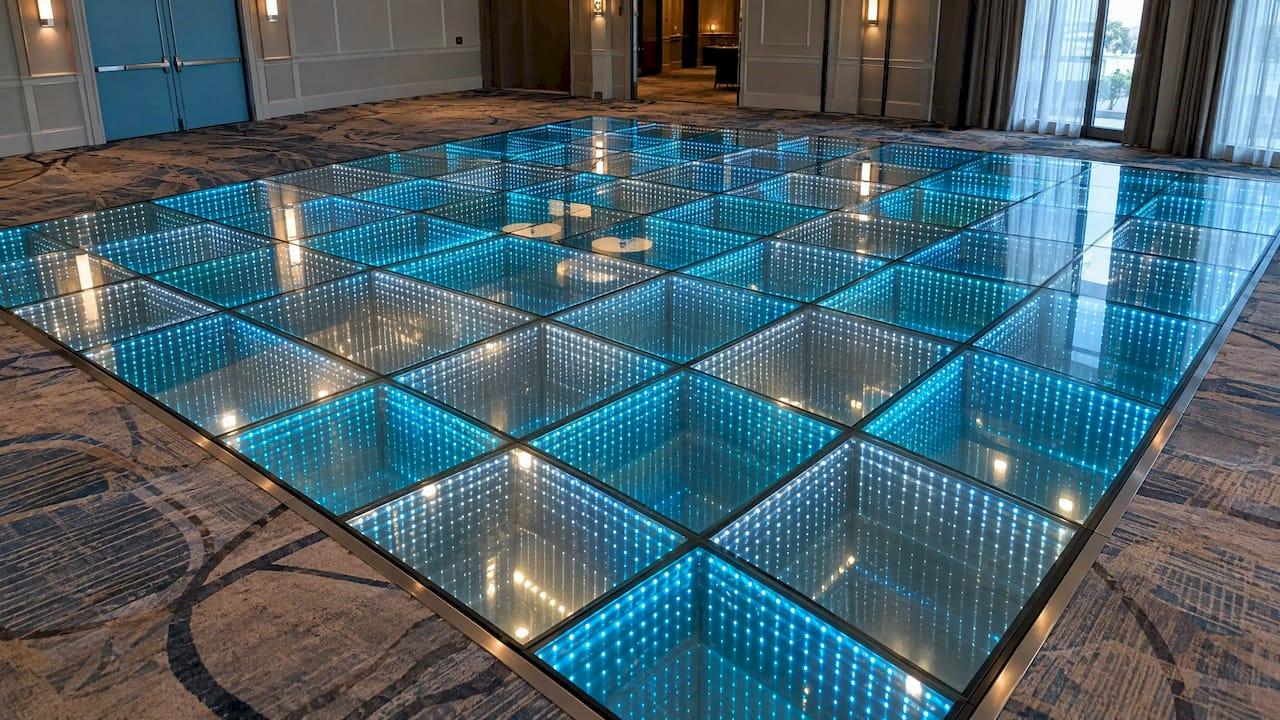
A lit floor is a different thing from lighting the floor. An LED floor is made of modular panels with an embedded LED matrix. One style, the infinity floor, adds a mirror layer under tempered glass to create the look of endless depth. Many professional panels are DMX-compatible, meaning a lighting controller can sync them with the rest of the rig. They are a feature in their own right and usually sit alongside overhead lighting rather than replacing it.
Build the floor in four layers
A simple way to plan is the layered approach lighting designers use. A typical dance floor layout has fill, motion, texture and accents:
| Layer | What it is | What it does for guests |
|---|---|---|
| Fill | Wash fixtures or uplights | Gives the floor and room a base color and keeps faces visible |
| Motion | Moving heads or scanners | Sweeps beams across the floor and follows the energy of the music |
| Texture | Lasers, gobos, sparkle effects, disco ball | Adds pattern, depth and a sense of movement |
| Accents | Strobes and big-moment effects | Marks drops, entrances, the last song of the night |
You do not need every layer to start. A wash plus a few moving heads is a solid base for a wedding. Texture and accents are what you add as the guest count, the venue height and the style of the night call for them.
How many fixtures and where to put them
For a mid-size dance floor, one venue’s guidance is two to four LED moving-head or wash fixtures mounted 8 to 10 feet up on truss or tripod stands. Treat that as a starting point, not a rule. A hotel ballroom with a 20-foot ceiling, a tent with a low peak and a loft with exposed beams all light differently.
Three things decide the real plan:
- Ceiling height and rigging. Low ceilings limit tall stands and make beams look cramped. High ceilings can need truss or a larger fixture to reach the floor with any punch. Ask the venue what can be hung and where power is available.
- Floor size and guest count. A small floor with 60 guests wants tighter, brighter coverage than a large floor that is half empty most of the night.
- Sight lines. Fixtures aimed straight into guests’ eyes are uncomfortable. Angles from the sides and above give the effect without the glare.
If you are comparing quotes, the point is not just the number of lights. It is what is on the floor, how it is programmed, and who runs it all night. At LJDJS our production and intelligent lighting offerings are designed to go with the DJ and MC, so the lighting follows the room rather than playing the same loop for four hours.
Dance floor lighting vs. uplighting
These get mixed up constantly, and a lot of wedding quotes list both. The difference is about purpose. Dance floor lighting is dynamic and responsive to the music, built to energize the dance area, while uplighting is generally static or slowly changing, placed around the edges of the room to accent architecture and set the mood.
In practice:
- Uplighting washes walls, columns and drapery in a chosen color. It makes a plain ballroom feel designed and it matches your palette.
- Dance floor lighting moves, pulses and changes with the songs. It does not describe the room, it describes the energy.
The two work best together. Uplighting sets the stage during cocktails and dinner, then the dance lighting takes over once the floor opens. We offer wireless uplighting because it can be placed without running cable across the room, which keeps the venue looking clean.
Wedding dance floor lighting: when it is worth it
If your reception has a real dance floor and you expect people to use it, lighting is one of the better places to put budget. It changes the feel of the night more than most decor items do, and you will see it in nearly every dance photo.
It matters most when:
- The venue is bright, plain or has overhead lights you cannot dim well. Lighting gives the floor its own identity.
- You want a clear shift between dinner and dancing. A change in the room’s lighting is a natural cue that the party has started.
- Your guest list loves to dance and you are planning a long dance set.
- Photos and video matter to you. Controlled lighting gives your photographer and videographer something to work with.
It matters less when the reception is a short cocktail-style evening with little dancing. Even then, a monogram or a soft wash on the floor can be enough.
A useful way to plan is by the reception timeline. Brighter, welcoming light for cocktails, focused light for the entrance and first dance, softer ambient light for dinner, balanced light on the speaker and head table for toasts, then more dynamic light and dimmed ambient levels for dancing. That phased approach is how we think about it too: each part of the night has a different job.
Lighting and photography: keep it flattering
This is where couples are most often surprised. Colored lighting looks wonderful in the room and can look odd on camera. A photographer writing about shooting after dark explains that broad, flooded color from DJ lighting flattens subjects and wrecks skin tones, leaving one person’s face purple and another’s green. The same photographer notes that disco balls added glitter reflections and that a little fog in the air broke the lights into small particles, both of which added depth to the frames.
A few practical rules:
- Choose a wash color you like on skin. Warm ambers, soft whites and gentle magentas tend to be kinder than saturated pure blue or green.
- Keep the head table and the floor adequately lit, so key moments are not shot in near darkness.
- Raise the lights for toasts, the cake cutting and the bouquet toss, then bring the party look back.
- Walk the room with your photographer before the event, and look at the lighting from where they will be standing.
If you want to see how color and movement behave in a real live-set image, this look at photographing a live DJ set shows how a photographer works with colorful lighting.
Because LJDJS also offers photography and videography alongside DJ and lighting, your lighting plan and your image plan can be shaped in the same conversation rather than negotiated between separate vendors.
Sound and lighting working together
Lighting does not carry a dance floor alone. Event sound and lighting have to agree: the music energy drives the lighting, and the lighting tells guests the music is for dancing.
One venue guide recommends running fixtures either from a basic DMX controller for programmed looks or in sound-active mode so they pulse with the music, with speakers raised 6 to 7 feet and angled toward the center of the floor. DMX is the standard control signal that lets one console direct many lights.
Sound-active mode is easy and reactive. Programmed looks give more polish. A live DJ who is also controlling the lights can combine the two: bring things up for the first chorus, go dark on a breakdown, hit an accent on the drop. That is the case for having the DJ and the lighting designed as one package.
Safety checks before the doors open
Haze, strobes and fast-moving beams are fine at a reception when they are handled responsibly. Before guests arrive:
- Walk the room with all effects running at full haze and full lighting, and confirm that every emergency exit sign stays visible from across the floor.
- Never aim a fixture at or near exit signage.
- Keep haze output at or below the level specified by the fire marshal or your venue contract, and ask the venue early whether haze is allowed at all, since some smoke detectors react to it.
- If anyone in your group has photosensitive epilepsy or a similar condition, tell your DJ and lighting team ahead of time so strobes and rapid flashing can be limited, and speak with the person’s doctor if you are unsure.
What a good lighting plan looks like on paper
When you ask for a quote, a clear plan should name:
- The fixture types on the floor (wash, moving heads, effects) and how many.
- Whether uplighting is included, and in which colors.
- Any monogram or custom projection, and where it will land.
- Whether haze is part of the plan, and the venue’s rules on it.
- Who programs and operates the lights during the night.
- A timeline of looks: cocktails, entrance, dinner, toasts, dancing.
Those six items are the difference between “we put lights on the floor” and a designed evening.
Lighting for corporate events and milestone parties
The same layered approach carries across event types. At a corporate gala, lighting often needs to support a brand color, a stage moment and a clean look for photos, then loosen up when the dance floor opens. At a Sweet 16, Quinceañera or Bar/Bat Mitzvah, the lighting is closer to a show: more motion, bolder effects and often video elements. If you are planning one of those, see our pages on Sweet 16 and Quinceañera and Bar/Bat Mitzvah entertainment. For business events, our corporate event design guide covers how the pieces fit.
Where LJDJS fits
LJDJS is an event design and entertainment company with more than 25 years of experience, serving New Jersey, New York and clients globally. Our lighting options include wireless uplighting, intelligent lighting, monograms, pin spotting, indoor cold sparklers and an indoor snow effect, and they pair with our DJ and MC team, the Piano DJ Booth and Chandelier DJ Booth, custom LED video walls and photo booths. You can see the range on our services page, and for weddings specifically on our wedding entertainment page.
If you are planning an event and want the lighting designed with the music, the booth and the photography from the start, reach out to LJDJS with your date, venue and guest count.
For a look at the budget side of the entertainment, our wedding DJ cost guide is a good next read.
Our perspective
We have spent over 25 years working dance floors, and the biggest lesson is that lighting is not decoration. It is part of the performance.
A DJ who reads the room can tell when a song needs a bright, open look and when it needs the floor to go dark with a few beams cutting through. When the same team designs the lighting, the booth, the video wall and the photography, those choices stay consistent. The piano or chandelier booth, a monogram on the floor, wireless uplighting around the room and intelligent lighting overhead tell one story instead of four.
We tailor each event to the style and culture of the people hosting it. A bilingual wedding, a Quinceañera and a corporate gala each want a different energy, and the lighting should show it. That is why we plan it as part of the full design, not as a rental line at the end.
LJDJS
FAQ
Do you need dance floor lighting at a wedding?
Not strictly, but it is one of the most visible upgrades if you expect real dancing. It gives the floor its own identity, signals that the party has started and gives photos and video more depth. If your venue is bright and plain, it matters even more.
What is the difference between uplighting and dance floor lighting?
Uplighting is placed around the room’s edges and stays static or changes slowly, accenting walls and architecture. Dance floor lighting moves and responds to the music to energize the dancing area. Most weddings use both, with uplighting for the room and moving lights for the floor.
What are the different types of dance floor lighting?
The main types are wash lighting for base color, moving heads and scanners for motion, and effects such as disco balls, lasers, strobes, gobo projections and haze for texture. Light-up LED floor panels are a separate option that lights the floor itself rather than lighting the floor from above.
How many lights does a dance floor need?
For a mid-size floor, two to four moving-head or wash fixtures mounted 8 to 10 feet up is a common starting point. Ceiling height, floor size and venue rules change the answer, so plan it with your DJ and venue together.
Sources
- The Ultimate DJ Lighting Buying Guide
- Lighting Effect Types, United States
- Fun Lighting Effects for DJ Events
- DJ Lighting Guide: Rave Lights and Party Laser Lights
- LED Infinity Dance Floor Buying Guide for Events
- Dance Floor Setup: Space, Sound and Layout Tips
- Dance Floor Lighting vs. Uplighting
- What Your Photographer Wants You to Know About Shooting After Dark
- Photographing a live DJ set