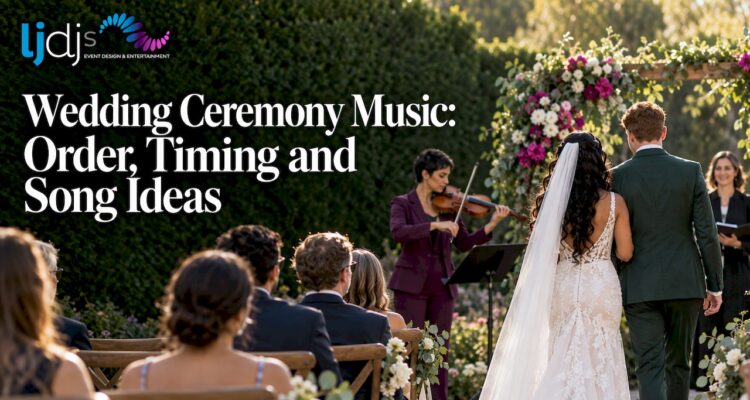
Ceremony music comes in a handful of moments: a prelude while guests arrive, a processional, optional music during a ritual or signing, a recessional and a short postlude. Most couples need about five to seven songs in all. Pick music that fits the mood you want, time it to your aisle, and put every cue on one sheet so whoever runs the sound knows exactly what to do. Below you will find the order, the timing math, song ideas for each moment, and how to coordinate it all on the day.
TL;DR
- A standard ceremony has six musical moments: prelude, seating of the family, processional, interlude, recessional and postlude. Not every ceremony uses all six.
- Plan roughly 5 to 7 songs for the ceremony itself, plus 20 to 30 minutes of background music as guests are seated.
- Time the processional by your aisle length and the size of your wedding party, then rehearse it once with the music.
- Decide between live musicians, a DJ and a playlist by budget, venue acoustics and the feeling you want in the room.
- Write a one-page cue sheet with song, start point and stop instruction, and hand it to your officiant, coordinator and sound operator.
Table of Contents
- The order of wedding ceremony music
- How many songs you need
- Timing the processional
- Song ideas for each moment
- Choosing music that sounds like you
- Live musicians, a DJ or a playlist
- Coordinating with your officiant, venue and sound operator
- Our perspective
- Plan the music with LJDJS
- FAQ
- Sources
The order of wedding ceremony music
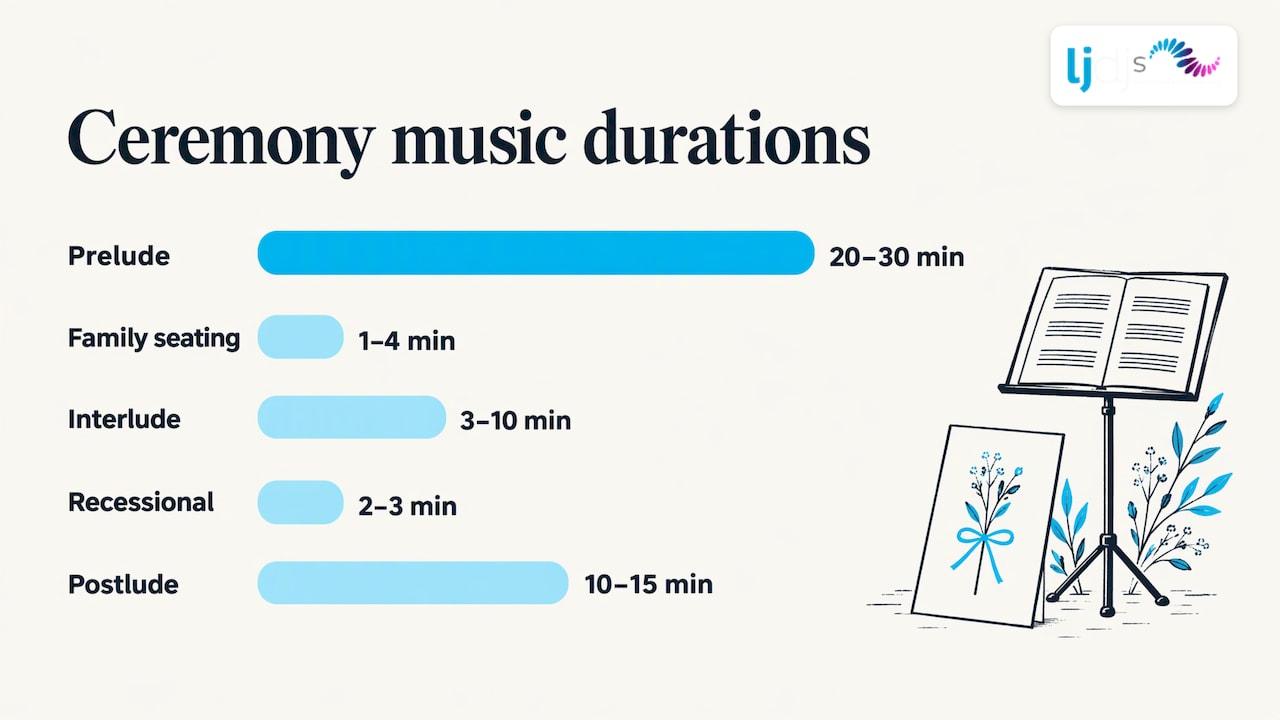
The classic sequence has six parts, as laid out in this ceremony music order guide. Here is what each one does and how long it usually runs.
| Moment | What it covers | Typical length |
|---|---|---|
| Prelude | Background music as guests arrive and sit | 20 to 30 minutes |
| Seating of the family | One or two songs for grandparents and parents | 1 to 4 minutes |
| Processional | Officiant or groom, wedding party, then the bride | 90 seconds to 4 minutes |
| Interlude | Quiet instrumental music during readings, a unity ritual or the signing | 3 to 10 minutes |
| Recessional | One upbeat, celebratory song for the exit | 2 to 3 minutes |
| Postlude | Background music while guests leave and mingle | 10 to 15 minutes |
The prelude and processional figures match what Wedding Player describes for a civil or celebrant-led ceremony: a 20 to 30 minute prelude, a processional of 90 seconds to 4 minutes, a signing of two or three songs over 5 to 10 minutes, and a recessional of 2 to 3 minutes. The postlude length comes from Paperlust’s moment-by-moment breakdown.
The ceremony body itself, the vows and the exchange of rings, usually has no music at all. Silence there is a feature. Guests lean in to hear the words.
The prelude sets the tone
The prelude is the part guests hear longest and think about least. Start it about 20 to 30 minutes before the ceremony. Joy suggests choosing 4 to 6 songs that reflect your style, and says instrumental versions of meaningful songs, classical pieces and acoustic arrangements all work well.
Keep the volume low enough for conversation, and keep the energy steady. A prelude is a warm-up, not a performance. If you want a nod to your story, this is the easiest place for it: instrumental covers of songs you love blend in without asking guests to pay attention.
Seating the family
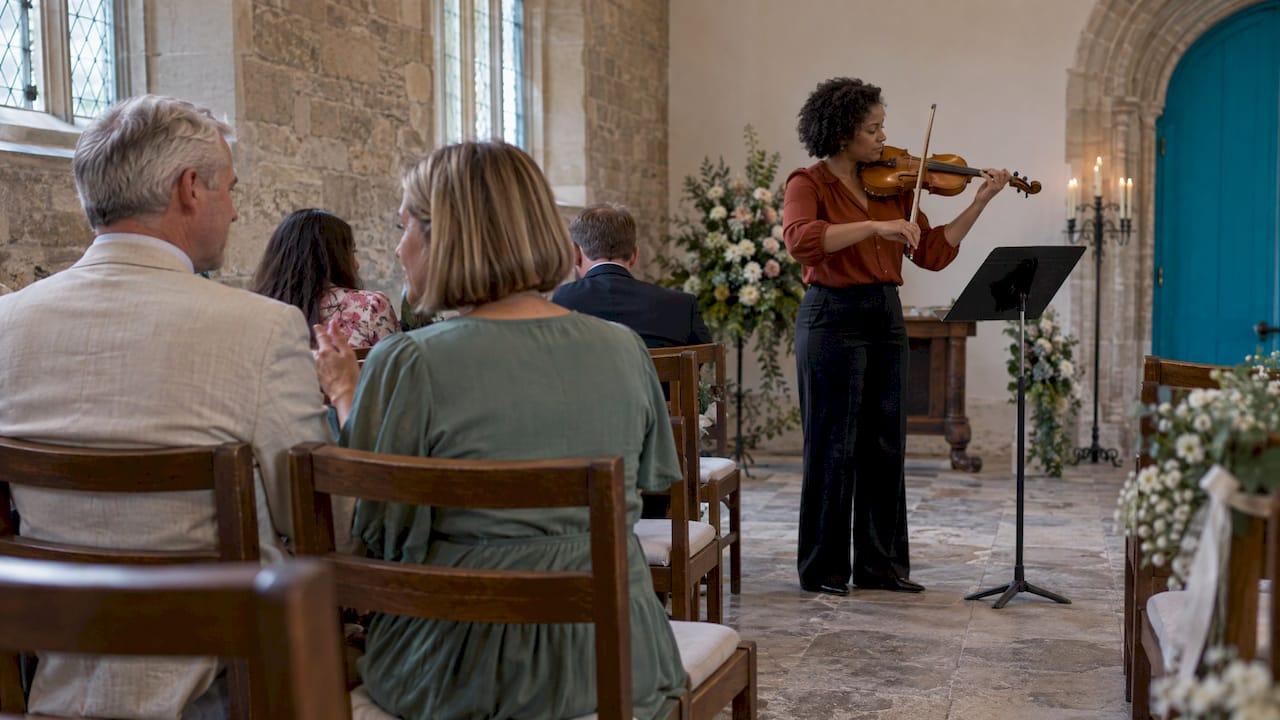
Grandparents and parents often get one or two songs of their own, usually softer than the prelude and a step before the processional. This is a good moment for a piece with family or cultural meaning, since the people it honors are the ones walking.
The processional
In most American ceremonies the processional is split into separate pieces: one for the officiant and groom, one for the wedding party, and one for the person or people who walk last. Some couples use one long song and cue it in segments. Others switch songs for the final entrance so the music changes character at the exact moment everyone stands.
The interlude and signing
If you have readings, a unity ritual, a blessing, or a marriage license signing, a quiet instrumental piece covers the moment. Paperlust’s table allows 3 to 5 minutes and one or two songs for a unity ceremony.
Recessional and postlude
The recessional is the ceremony’s exclamation mark: one upbeat song, 2 to 3 minutes, as you walk out. The postlude is background music that keeps playing while guests stand, hug and move toward cocktail hour. Many couples reuse prelude-style playlists here.
How many songs you need
There is no fixed number. Wedding Seat notes that most couples use six to eight songs across the whole ceremony, and that three or four is enough if you want to keep things simple. Joy puts the ceremony portion at 5 to 7 songs, within a full-day wedding playlist of roughly 150 to 200.
Paperlust’s breakdown gives a useful per-moment guide:
| Moment | Length | Songs |
|---|---|---|
| Prelude | 20 to 30 min | 5 to 10 |
| Wedding party processional | 3 to 6 min | 1 to 2 |
| Bride or groom processional | 1 to 2 min | 1 |
| Unity ceremony | 3 to 5 min | 1 to 2 |
| Recessional | 2 to 3 min | 1 |
| Postlude | 10 to 15 min | 3 to 5 |
A short, intimate ceremony with a small party might need only a prelude playlist, one processional song and one recessional. A large, multi-part ceremony with family seating, a unity ritual and a cultural blessing will land at the high end.
Timing the processional
The processional is the most timing-sensitive part of the ceremony. It is where a song that is too short ends with people still walking, and one that is too long leaves the couple standing in silence.
Start with your aisle. Plan A Wedding notes that a typical aisle runs 60 to 100 feet and that, at a natural wedding pace, each attendant takes about 25 to 30 seconds from the door to their spot. Ten attendants walking in pairs need about two and a half minutes of music.
Paperlust’s timing formula is more formal: a ceremonial pace of 1.5 to 2 feet per second means a 60-foot aisle takes roughly 30 to 40 seconds per person. A party of six, as three pairs spaced 10 seconds apart, takes about 90 seconds. For the final entrance, it suggests a song of 3 minutes or more, or a mid-song start so the emotional peak lands as you arrive.
The figures differ because aisles and walking speeds differ. Sortra’s timing guide puts a typical processional walk at 45 to 90 seconds per group. Your best method is simple:
- Measure or ask your venue for the aisle length.
- Count how many entrances you have and how they are grouped.
- Walk it once at your real pace during the rehearsal, with the music playing.
- Mark the exact second each song should start, and where it should fade.
Sortra recommends a brief rehearsal for this reason. Walk the aisle at normal pace, check whether the music reaches the right point by the time each person arrives, and settle who gives the cue to start each song and where the musician should look for a visual signal.
Song ideas for each moment
These suggestions come from a venue’s list of ceremony picks. Use them as a starting point and adapt them: instrumental or acoustic versions suit the processional and signing, and the original recordings suit the exit.
Processional
- Canon in D by Pachelbel
- Marry Me by Train
- Somewhere Over the Rainbow by Israel Kamakawiwoʻole
- Unchained Melody by The Righteous Brothers
- The One by Kodaline
Final entrance
- Here Comes the Sun by The Beatles (instrumental)
- Glasgow Love Theme from Love Actually
- I Get to Love You by Ruelle
- Turning Page by Sleeping At Last
- You Are the Reason by Calum Scott
Interlude or signing
- Ave Maria by Schubert
- All of Me by John Legend (piano instrumental)
- Hallelujah (acoustic)
- You Raise Me Up by Josh Groban
- Feels Like Home by Chantal Kreviazuk
Recessional
- Signed, Sealed, Delivered by Stevie Wonder
- Best Day of My Life by American Authors
- Happy by Pharrell Williams
- You Make My Dreams by Hall & Oates
- Love on Top by Beyoncé
A quick test for any song: play the first 30 seconds with the lyrics off. If it still feels right, an instrumental version will work. If the meaning lives in the words, consider whether guests will hear them during a walk or a ritual, and whether those words say what you want said at that moment.
Choosing music that sounds like you
Start with the feeling, not the genre. Meg Keene at A Practical Wedding says ceremony music works best when it is somewhat emotional and not crass, and when guests feel wrapped in it rather than trying to work out what it is. That is a handy filter: if people will spend the aisle walk puzzling over a song, it may belong at the reception.
A few ways to narrow the list:
- Match the room. A garden, a ballroom and a house of worship each carry sound differently. Strings and piano suit quiet spaces. A big space can handle fuller arrangements.
- Match the formality. A classical processional signals tradition. An acoustic pop cover signals warmth. A song everyone knows signals fun.
- Save the high energy. Keep the loudest, most danceable choices for the recessional and reception.
- Give each person a moment. Parents, grandparents and the wedding party can each have a different piece so the music marks who is walking.
Bringing in cultural traditions
Music is one of the simplest ways to honor your heritage without adding another spoken segment. Forever, Together advises talking through what each tradition means to each of you before deciding what to include, and notes that some couples place cultural music in the processional, cocktail hour or reception entrance instead of adding another ritual.
For Jewish weddings, Rabbi Eliyohu Krumer describes music drawn from liturgical melodies, Hasidic niggunim, klezmer dance tunes, Israeli songs and contemporary pop, with each musical moment having its own mood, tempo and purpose. If both families bring different languages or traditions, a bilingual DJ or MC can also help every guest follow what is happening. For more on that kind of event, see our guide to choosing a Bar Mitzvah DJ.
Live musicians, a DJ or a playlist
There are three common ways to deliver ceremony music, and the choice comes down to budget, venue acoustics and the emotional weight you want the music to carry. Paperlust’s figures put live musicians at $500 to $2,500 or more, a DJ ceremony add-on at $200 to $800, and a streamed playlist at $0 plus setup. Those are general ranges, so confirm local pricing with the people you are considering.
| Option | Best for | What to confirm |
|---|---|---|
| Live musicians | Intimate spaces, classical or acoustic sound, a strong visual moment | Rehearsal, power access, weather plan |
| DJ with ceremony audio | Mixed styles, exact recordings, microphones for the officiant and vows | Wireless mic, speaker placement, backup source |
| Streamed playlist | Small budgets, informal settings | Sound system, a volunteer to press play, no ads or interruptions |
A DJ already running your reception can also keep the whole day consistent: the same sound system, the same person who knows your cue sheet, and no handoff between the ceremony and cocktail hour. If you are weighing costs, our breakdown of what couples really pay for a wedding DJ explains what typically shapes the price. For the technical side of sound and screens, see our overview of event audio visual services.
If you also want the ceremony audio and the moment itself captured on video, wedding audio and video planning lays out what to arrange so the recording sounds as good as the day felt.
Coordinating with your officiant, venue and sound operator
Build a one-page cue sheet before the rehearsal. Plan A Wedding recommends giving a copy to the officiant, coordinator and whoever controls the sound, with each cue listing the song title, artist, exact start point and stop instruction: a hard stop, a fade over eight seconds, or play to the end.
A sample line looks like this:
- Bride entrance. Song title and artist. Start at 0:45. Fade over eight seconds once the bride reaches the front.
- Signing. Song title and artist. Play from the beginning. Hard stop when the officiant begins to speak.
- Recessional. Song title and artist. Start at the chorus. Play to the end and roll straight into the postlude playlist.
Also settle who gives the signal for each cue: a coordinator with a hand signal, or the officiant with a nod. It is the small detail that keeps everyone from guessing.
Houses of worship
Church music is often more structured than at secular venues. According to Sortra’s church wedding guide, some churches require music director approval and allow only hymns, organ pieces, choral selections or instrumental music suited to worship. Ask whether recorded music is allowed, whether there is a built-in sound system, and whether outside musicians need to rehearse in advance. Do this before you fall in love with a song list.
Our perspective
We have spent more than 25 years watching weddings from the booth, and the ceremony is where we see couples underestimate music most. The reception gets the attention, yet the ceremony is the one moment when every guest is quiet and listening.
Our view is that ceremony music should be planned as a whole, not song by song. We work with couples on the prelude, the processional, the signing and the exit as one sequence, and we match it to their style and culture, whether that means bilingual announcements, music from two traditions, or a favorite pop song arranged for piano.
It also helps when the same team handles the sound for the ceremony and the party. The microphone for your vows, the cue for your entrance and the first song at the reception all run from a plan we have already walked through with you. Our Piano DJ Booth and Chandelier DJ Booth are designed to make the music a visible part of the room, not just something heard from a speaker.
LJDJS
Plan the music with LJDJS
We design and run entertainment for weddings in New Jersey, New York and beyond, from ceremony sound and a bilingual DJ or MC to lighting, monograms and LED video walls. Our team builds the cue sheet with you, matches the music to your style and culture, and runs it all on the day. See our wedding entertainment page to start planning.
If you want the ceremony itself to look as polished as it sounds, our Piano DJ Booth and Chandelier DJ Booth are built to be seen. Monogram projection can finish the look, and our guide to wedding gobo lighting explains how it works. We also offer photography and videography to capture the moments you planned.
FAQ
Is music required during a wedding ceremony?
No. Many ceremonies use music only for the processional and recessional, and the vows themselves usually have none. The prelude, interlude and postlude are optional, but most couples include at least a prelude and a recessional so the room never feels empty.
How long should the processional song be?
It depends on your aisle and your party. A 60-foot aisle takes roughly 30 to 40 seconds per person at a formal pace, so a party of six takes around 90 seconds. Choose a song of 3 minutes or more, or start mid-song so the peak arrives as you walk in.
Can I use popular songs with lyrics for the ceremony?
Yes, and many couples do. Instrumental or acoustic versions are easier to talk over and to hear during a walk, while the original recording usually works best for the recessional. Check with your officiant or venue first, since some houses of worship limit recorded music.
Should I hire live musicians or a DJ?
Live musicians suit intimate spaces and a classical or acoustic sound. A DJ suits ceremonies that mix styles, need exact recordings or need microphones for the officiant. Many couples choose the DJ so one team handles the sound for the entire day.
Sources
- Wedding Ceremony Music Order, Wedding Seat
- Wedding Ceremony Music Order, Wedding Player
- Wedding Ceremony Order of Events, Joy
- Wedding Music Playlist Guide, Joy
- Wedding Ceremony Music: 80+ Song Ideas, Paperlust
- Wedding Ceremony Music Guide, Plan A Wedding
- How to Time Wedding Ceremony Music, Sortra
- How to Plan a Church Wedding, Sortra
- Music Picks From Processional to Recessional, Events at Judson Mill
- 57 Wedding Ceremony Songs, A Practical Wedding
- How to Blend Cultural Traditions at Your Wedding, Forever, Together
- Jewish Wedding Music Guide, This Is Bar Mitzvah
- Audio y vídeo de boda