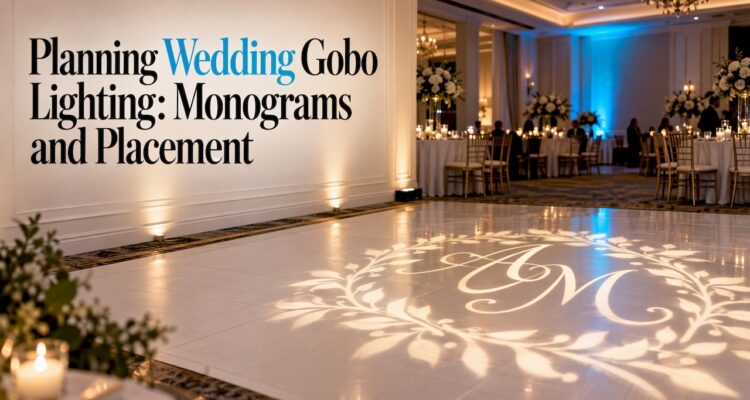
Wedding gobo lighting is a way to project a pattern, your monogram or a custom design onto a dance floor, wall or ceiling using a light with a template inside it. It is one of the simplest ways to put your names and your style into a room you do not own. The result depends on four things: the design, the surface, the distance and the room’s other lighting. This guide covers all four, so you can brief your entertainment team with confidence.
TL;DR
- A gobo is a template placed in a light source so the beam projects a shape. At a wedding that is usually your monogram, a date, a pattern or a motif.
- The most popular spots are the dance floor, a blank wall behind the head table or cake, the entrance and the ceiling.
- Clarity comes from throw distance, image size, surface color, and how much other light is in the room.
- Keep the design simple: bold shapes read better than thin script from across a ballroom.
- Decide on your monogram early, then ask your DJ or lighting team to test it on site before the guests arrive.
Table of Contents
- What gobo lighting is and how it works
- Monogram gobos versus other wedding gobos
- Where to project a gobo at your wedding
- What affects how sharp the projection looks
- What to put in a custom monogram design
- A short planning timeline
- Our perspective on gobo and monogram lighting
- Making gobo lighting part of the whole night
- Questions to ask any provider
- Add monogram lighting to your wedding with LJDJS
- Common mistakes to avoid
- FAQ
- Sources
What gobo lighting is and how it works
A gobo is an object placed inside or in front of a light source to control the shape of the light and its shadow. In theatrical lighting, the term refers to a device that sits at the point of focus between the lamp and the lenses. The spacing between the gobo and the lens changes the size and focus of the projected image.
Think of it as a stencil for light. Light passes through the cutouts and is blocked everywhere else. The lens then focuses what gets through onto a surface, the way a slide projector does.
For weddings, Junebug Weddings describes gobo lighting as a custom template that light shines through to create a pattern, monogram or motif on a floor, ceiling or wall. That definition matches how most couples use it. You are not buying a lighting fixture. You are buying a design that lives on the surfaces of your venue for the night.
Why couples choose it
Three reasons come up again and again:
- It personalizes a neutral room. A hotel ballroom or banquet hall looks like every other one until your initials are glowing on the floor.
- It photographs well. A projected monogram gives your photographer and videographer a backdrop that is unmistakably yours.
- It leaves no mess. Nothing is hung, taped or stuck to the venue, so there is little to clear out or clean up at the end of the night.
Monogram gobos versus other wedding gobos
People search for “gobo lighting” and “monogram lighting” as if they were different products. They are the same technique with different content.
A monogram gobo carries a design made from your names or initials. Common layouts include:
- Two or three initials in a classic interlocking arrangement
- First names joined by an ampersand or a plus sign
- Last name with an established year
- A wedding date with a simple border
A pattern or motif gobo has no names in it. Examples include leaves, stars, florals, lace-like patterns, geometric shapes, a skyline or a symbol that matters to your culture or faith. Venues often use these on ceilings or walls to add texture, while the monogram goes on the dance floor or the focal wall.
Many couples use both: a pattern to wash the room in atmosphere and a monogram for the moment that matters, such as the first dance.
Where to project a gobo at your wedding
The projection surface changes how the design looks, so choose the spot before you finalize the artwork. According to Instagobo’s wedding ideas, the usual places are the dance floor, dining area, a wall or ceiling, and an entrance, and the same technique works for a grand-exit effect. Here is how each plays out in practice.
The dance floor
This is the classic placement. Guests see your monogram during the first dance, and it frames the photos from that moment. A smooth, light-colored floor shows the design best. Dark or heavily patterned floors, such as a carpeted ballroom or a deep wood parquet, reduce contrast. If the floor is dark, ask about a portable dance floor in a lighter finish.
Dancing guests will walk through the beam and cast shadows over the design. That is part of the look, but it means the projection works best as a first-dance feature and a backdrop for open dancing, not as a message you need guests to read.
A feature wall
A blank, light-colored wall behind the head table, sweetheart table, cake or photo area is the most legible spot, because no one blocks the beam. The same goes for a wall at the entrance, where guests meet your names as they arrive.
If the wall has wallpaper, wood paneling, windows or heavy drapery, the image breaks up. Walk the room with your venue coordinator and note which walls are plain.
The ceiling
A ceiling pattern can turn a flat ballroom into something that feels designed. It is also the hardest to get right. Instagobo cautions that patterns covering a whole wall or ceiling can need several projectors and professional lighting expertise. This is where a professional production team earns its fee instead of a do-it-yourself setup.
Entrance, bar and exit
A smaller gobo at the door, over the bar or on the pathway of your send-off adds a finishing detail without competing with the main design. For outdoor and tent weddings, remember that projection needs a surface and darkness. A tent liner can work as a screen once the sun is down, but daylight washes the image out.
What affects how sharp the projection looks
A gobo that looked crisp in a catalog photo can look soft in a real room. Most disappointments come from the same few variables. Signovation’s overview of gobo projectors lists throw distance, projection size, lens, mounting position, surface and ambient light as the factors that govern clarity and placement. Here is what each means for you.
| Factor | What it does | What to ask |
|---|---|---|
| Throw distance | The farther the light travels, the larger and softer the image | How far will the unit be from the floor or wall? |
| Image size | A bigger image spreads the same light over more area, so it looks dimmer | Is this size right for the guest count and room? |
| Lens | Changes the size and sharpness at a given distance | Which lens will be used for this room? |
| Mounting position | A unit on a truss or stand at a steep angle can stretch the image | Where will the light sit, and at what angle? |
| Surface | Light, smooth and matte surfaces show the most detail | What color and finish is the floor or wall? |
| Ambient light | Uplighting, candles and house lights wash out the projection | Can lights near the projection be dimmed? |
The practical lesson: the projection competes with every other light on the same surface. If you want a vivid monogram on the dance floor, do not aim bright colored uplights across that floor. Aim them at walls and keep the floor area darker.
What to put in a custom monogram design
A gobo is a stencil, so it behaves like a stencil: everything must hold together as a shape. That affects the design in a few ways.
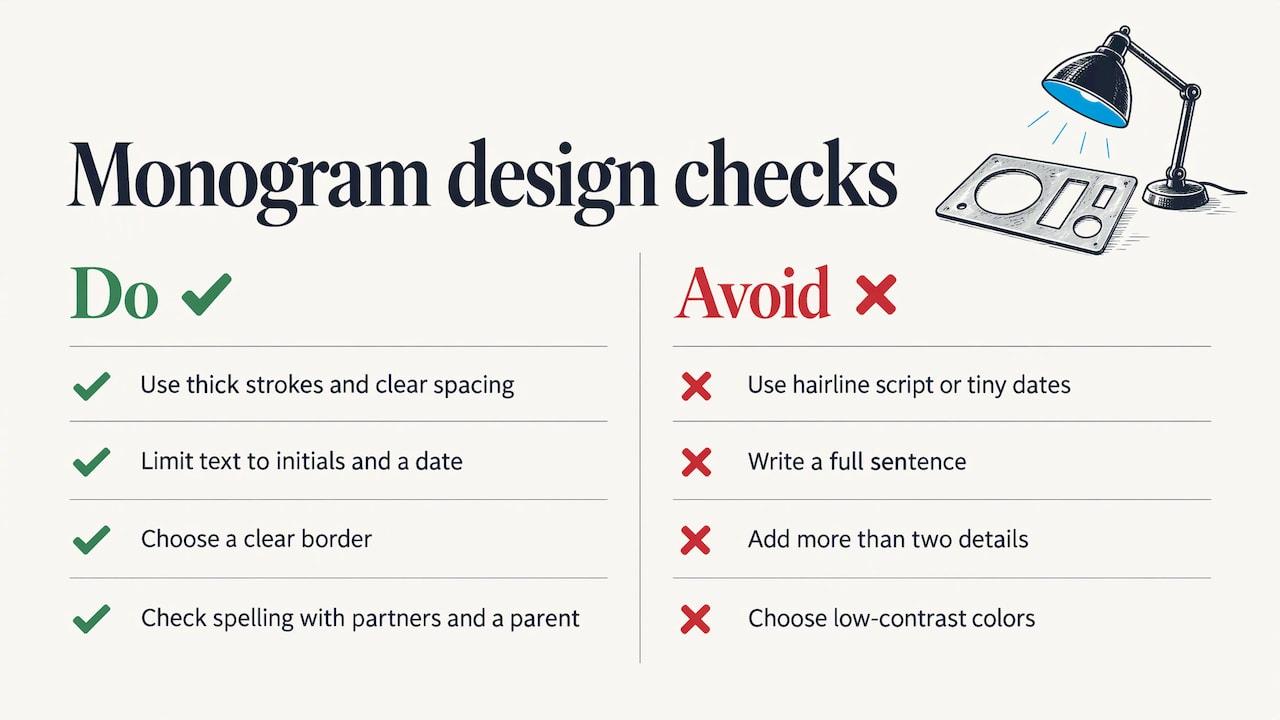
Keep it bold. Thin hairline script and tiny dates disappear once light spreads across a floor. Choose a design with thick strokes and clear spacing. If you love a delicate script, ask the designer how it will look at the size you plan to project.
Limit the words. Initials and a date read at a glance. A full sentence does not.
Think about the border. A circle, a wreath, linked rings or scrollwork gives the design a clear edge, so it looks deliberate when the light spills over an uneven floor.
Add meaning, not clutter. Some couples include a symbol from one or both cultures, a pet silhouette, a city skyline, or the venue’s name. Pick one or two details and leave the rest out.
Mind the spelling and the date format. Check every letter and numeral with both partners and a parent before the design is finalized. A typo in a projected image is hard to miss and impossible to fix mid-reception.
Check the colors. Most traditional gobos project white or the color of the lamp or filter. Digital systems can show full-color or animated designs. Choose a color that fits your palette but still contrasts against the surface.
Static or digital
A traditional gobo uses a physical template, usually metal or glass, so the image is fixed. A digital setup sends the design through a video projector or a lighting fixture that can display images, which allows color, movement and design changes during the night. Some couples use a static monogram for the first dance and switch to animated patterns for open dancing. The right choice depends on the room, the budget and your team’s equipment, so ask what they have available rather than assuming.
A short planning timeline
Gobo lighting is not hard to arrange, but it works better when you decide early.
- When you book your entertainment: ask whether monogram projection is offered and how it is set up. It is easiest to add when the same team handles your music and lighting.
- Several months out: visit the venue, or send photos, and identify the floor, walls and ceiling you could use. Ask the venue about rigging limits and power access.
- Two to three months out: settle your names, date and style. Request a proof of the design before it is made.
- The final weeks: confirm the lighting plan for the evening, including when house lights dim and when the projection turns on.
- The day itself: have the team set up and test the projection in the room before cocktail hour ends, ideally with the same lighting guests will see.
Those timings are a sensible rhythm, not a rule. Your venue and your team may need more or less lead time.
Our perspective on gobo and monogram lighting
We have been designing and producing celebrations for over 25 years, and the lesson we keep coming back to is that lighting should serve the moment, not decorate for its own sake.
A monogram on the floor is lovely, but it works when it is part of a plan. We look at the room, the flow of the night and the moments you will want to remember, and then decide where a projection belongs. That is why we treat monograms as one piece of event design, alongside uplighting, intelligent lighting, LED video walls and the DJ booth.
We also think the people running your music should be involved in your lighting. When the DJ, MC and lighting team work as one crew, the monogram turns on for the first dance, the room dims at the right time, and no one is hunting for a switch. It is also why we build custom setups such as our Piano DJ Booth and Chandelier DJ Booth: the booth itself becomes part of the room’s design.
Every couple has a different style and often a different culture. We design with that in mind, whether that means a bilingual MC, a particular symbol in your monogram, or a mix of music from more than one tradition. Your names in light should look like you.
LJDJS
Making gobo lighting part of the whole night
A projection is strongest when it connects with everything else the room is doing. A few combinations work well.
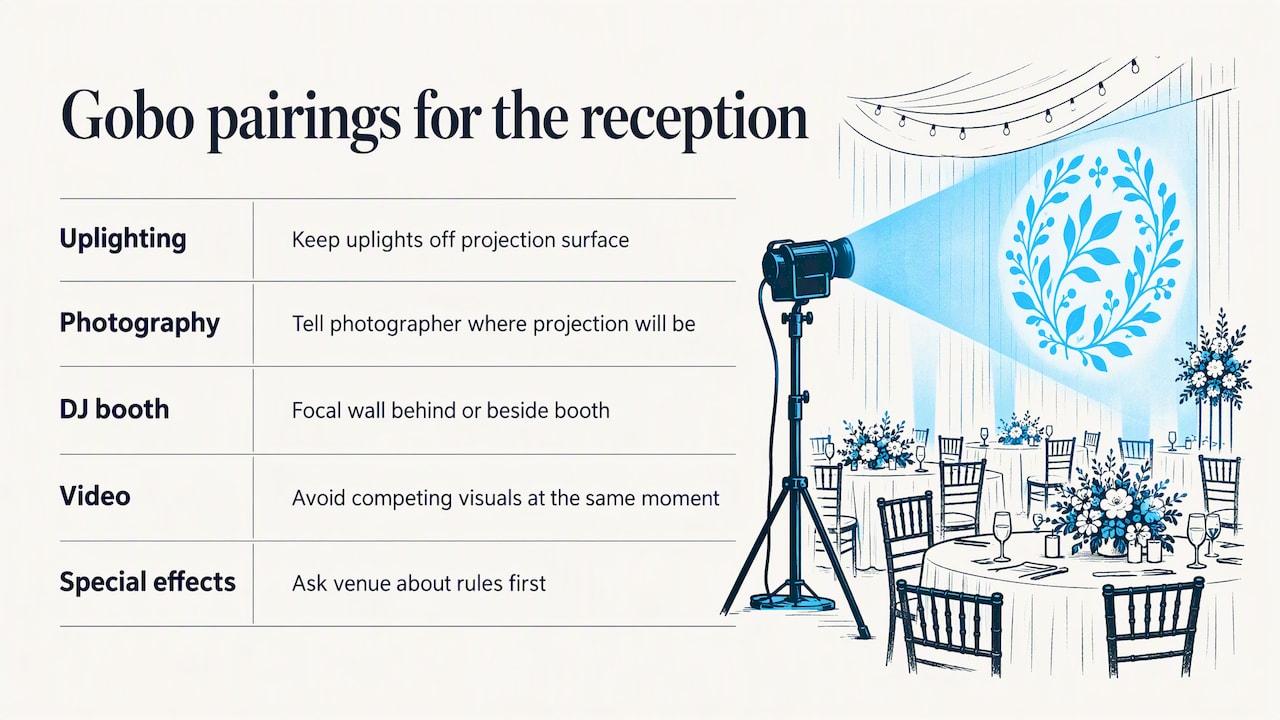
Monogram and uplighting. Wireless uplighting washes the walls in your palette while the monogram sits on the floor. Keep the uplights off the projection surface so the design stays crisp.
Monogram and photography. Tell your photographer where the projection will be. Photos of the first dance, with your initials on the floor, are a natural fit, and a team that handles lighting and photography and videography together can plan angles in advance.
Monogram and a DJ booth. A focal wall behind or beside the booth can carry the design, which keeps the lighting and the music area visually connected.
Monogram and video. LED screens and video walls can show your names and a photo montage, while the gobo handles the floor. Do not let both compete for attention at the same moment.
Monogram and special effects. Indoor cold sparklers and snow effects can punctuate the first dance or your entrance. Ask your venue about its rules on effects before you plan them.
Questions to ask any provider
Whoever you hire, a few questions separate a smooth setup from a stressful one.
- Will you visit the venue, or review photos and measurements, before the event?
- Which surfaces do you recommend for projection, and why?
- Is the design a fixed template or a digital image, and can it change during the night?
- Who will set up, test and run it, and when will it be ready?
- What happens if the room is brighter than expected or the floor is dark?
- How does it fit into the music timeline, including the first dance and the grand entrance?
- Does the venue allow the equipment, power needs and any mounting?
A provider who answers these specifically has done this in real rooms.
Add monogram lighting to your wedding with LJDJS
We design and produce weddings across New Jersey and New York, and we travel internationally. Our team offers monogram projection along with wireless uplighting, intelligent lighting, LED video walls, photo booths and bilingual or international DJs and MCs, so one crew can plan how your names, your music and your room work together.
To see how we approach a full celebration, start with our wedding entertainment page, or browse the lighting and enhancement options. If you are planning something bigger, our Piano DJ Booth and Chandelier DJ Booth show how a booth can become a centerpiece. When you are ready to talk dates and ideas, reach out through LJDJS Event Design & Entertainment.
Common mistakes to avoid
- Choosing the design last. The artwork depends on the surface and size, so settle the spot first.
- Fighting with other lights. Bright colored uplighting on the same surface washes out the image.
- Over-detailing. Fine lines and small text blur in the room.
- Skipping the site check. Floor color, ceiling height and wall texture decide the result. Have it tested before guests arrive.
- Forgetting the timeline. Decide when the monogram turns on and off, and tell your DJ, MC and photographer.
- Ignoring venue rules. Some venues limit rigging, power use or effects. Ask early.
FAQ
What is the difference between gobo lighting and monogram lighting?
They are the same technique. Gobo lighting is the method, in which light passes through a template to project an image. Monogram lighting is the most common wedding use, where that image is made from your initials or names.
Where is the best place to project a wedding monogram?
The two most common choices are the dance floor and a plain, light-colored wall. The floor frames your first dance, while a wall is easier to read because guests do not walk through the beam. Dark floors and textured walls reduce clarity, so walk the room first.
Can a gobo cover a whole ceiling or wall?
Sometimes, but it is harder. Large patterns can need more than one projector and professional lighting expertise, so ask your production team to plan and test it. A single focal point is simpler and usually more reliable.
Will a monogram be visible in a bright room?
Not as well. Projection loses contrast against ambient light, including house lights, candles and uplighting. Plan for dimmer lighting around the projection, or choose a surface in a darker part of the room.
How far ahead should I plan wedding gobo lighting?
Decide when you book your entertainment, and finalize the design a couple of months out. That leaves time for a proof, a venue check and corrections to spelling or layout.
Sources
- Gobo (lighting), Wikipedia
- The Ultimate Guide to Wedding Lighting, Junebug Weddings
- 5 creative ways to use gobo lighting at your wedding, Instagobo
- Gobo Projector for Weddings & Events, Signovation
Pingback: Bar Mitzvah DJ: How to Choose One and Plan the Party – LJDJs Event Design & Entertainment
Pingback: Event Audio Visual Services: What They Include and How to Book – LJDJs Event Design & Entertainment
Pingback: Wedding DJ Cost in 2026: What Couples Really Pay – LJDJs Event Design & Entertainment
Pingback: Video Testimonial Booth: How It Works and Ideas That Get Real Stories – LJDJs Event Design & Entertainment
Pingback: Sweet 16 Entertainment: DJs, Dances and Activities That Work – LJDJs Event Design & Entertainment
Pingback: Event Design Services: What They Include and How to Hire – LJDJs Event Design & Entertainment
Pingback: New Jersey Wedding DJ: Costs, Services and How to Choose – LJDJs Event Design & Entertainment
Pingback: Dance Floor Lighting: Layers, Placement and Planning – LJDJs Event Design & Entertainment