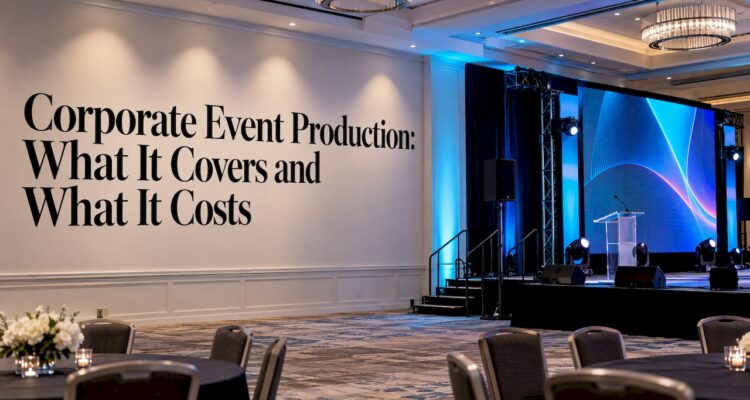
Corporate event production is the technical and creative side of your event: the sound, lighting, video, staging, entertainment and show-day management that turn a plan into something your guests experience. A good production partner designs it with you, builds it, runs it on the day and strikes it afterward. Below, we explain what that includes, how the process runs, what moves the budget, and how to choose a team.
TL;DR
- Production delivers the technical and creative elements of an event. Management and planning cover strategy, logistics and administration.
- Typical scope: audio, lighting, video and LED screens, staging, entertainment, emcee or MC, photography and videography, and show-day crew.
- Production cost depends mostly on room size and technical complexity, not on headcount alone. Technical labor is often a large share of it.
- Start with the audience and the run of show, then pick the technology. Not the other way around.
- Ask for a written scope, a load-in schedule and a named show-day lead before you sign.
Table of Contents
- What a corporate event production company does
- Event production vs. event management vs. event planning
- What corporate event production includes
- How corporate event production works, from planning to show day
- What corporate event production costs in the US
- How to make a corporate event more engaging
- Our perspective: production is part of the message
- Work with LJDJS on your next corporate event
- How to choose a corporate event production partner
- FAQ
- Sources
What a corporate event production company does
Event production is the process of planning and executing an event. Cvent describes it as covering the event concept, venue selection, catering, lighting, sound, staging, on-site technology and logistics. In practice, companies split that list differently. Some handle everything. Others own the technical and creative layer and work alongside your planner or venue.
For a corporate client, the work usually falls into five jobs:
- Design. Turning the purpose of the event (a product launch, a sales kickoff, an awards night, a holiday party) into a look, a flow and a technical plan.
- Technical build. Specifying and installing sound, lighting, video, staging and power so everything works in your specific room.
- Content and entertainment. Presentation playback, walk-in music, an MC, a DJ or live band, specialty acts, and moments built for the crowd.
- Documentation. Photography and video for internal communications, social media and recap reels.
- Show-day management. Cueing the program, calling the transitions, and solving problems while guests never notice.
The industry has been moving in this direction for a while. The International Association of Exhibitions and Events has noted that production contractors increasingly combine logistics with strategy, creative, audio-visual and experiential audience-engagement capabilities, rather than only supplying equipment. That matches what clients ask us for: not a box of gear, but a room that works.
Event production vs. event management vs. event planning
The three terms overlap, and vendors use them loosely. A workable distinction, consistent with Eventbrite’s guide: event management focuses on overall strategy, planning, logistics and organizational detail, while event production delivers the technical and creative elements that bring the concept to life.
| Planning | Management | Production | |
|---|---|---|---|
| Main question | What are we doing, and when? | Who does what, within what budget? | What will people see, hear and feel? |
| Typical outputs | Date, venue, guest list, agenda | Vendor contracts, budget, registration, logistics | Stage and room design, AV, lighting, entertainment, show control |
| Who owns it | Internal team or planner | Planner, agency or internal lead | Production company or in-house production team |
| Peak workload | Months before | Weeks before | Final days and show day |
Most corporate events need all three. If you already have a planner or an internal events team, you may only need production. If you are a small team running a once-a-year gala, a partner who can design the experience and run the technical side takes a lot off your plate.
What corporate event production includes
Scope varies by event, but these are the building blocks. Every item below is something we can supply or coordinate through our production services and our wider event enhancements.
Sound and music
Speech has to be intelligible in every seat before anything else matters. That means the right speakers for the room, wireless microphones on fresh batteries, a backup plan, and a technician at the mixing position. Music then sets the tone: arrival playlists, cocktail hour, dinner, and the dance floor if your event has one. A professional DJ and MC covers all of these, and can run the program as the voice of the evening.
Lighting
Lighting does two jobs: it makes the stage readable on camera and in the room, and it changes how the space feels. Wireless uplighting washes walls in your brand colors. Intelligent lighting adds movement and focus for an awards segment or a dance set. Monogram or logo projection puts your company mark on the floor or wall without a printed banner.
Video, LED screens and walls
Presentations, live camera feeds, sponsor loops and brand films all need screens sized for the farthest seat. LED video walls give a brighter, seamless image in rooms where projection struggles with ambient light. We offer LED TV screens and custom LED video walls, built to the room and the content.
Staging and set design
A stage is more than a platform. Height, depth, stairs, lectern placement and backdrop all affect sightlines and how comfortable speakers feel. Custom DJ booths, including our Piano DJ Booth and Chandelier DJ Booth, work as design features as well as performance stations, which suits a gala or a client-appreciation evening where the entertainment area is part of the decor.
Entertainment and engagement
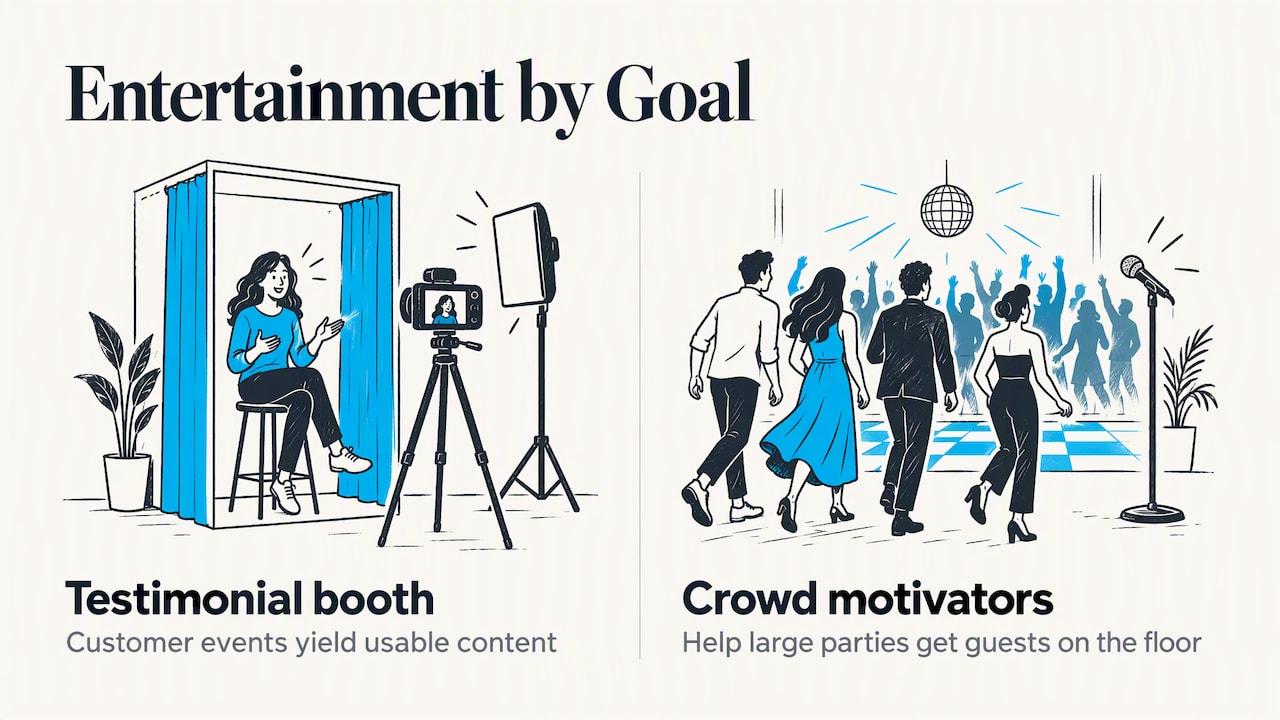
This is where production overlaps with the attendee experience. Options include live musicians, specialty acts, crowd motivators, photo booths (classic or video testimonial), indoor cold sparklers, an indoor snow effect and RFID bands. Use them with a purpose. A video testimonial booth at a customer event produces usable content. Crowd motivators help a large holiday party get on the floor. Choose by goal, not novelty.
Photography and videography
People forget to budget for documentation, then want it afterward. Our photography and videography team works in-house, so coverage lines up with the program and the lighting design.
How corporate event production works, from planning to show day
Every production team has its own method, but the sequence is consistent. Timelines flex with scale. One planning guide suggests a large conference or corporate gala may need up to 12 months of lead time, while smaller events run on much shorter ones.
1. Discovery and goals
We start with questions, not equipment. Who is attending? What should they think, know and do afterward? What does the CEO need to say, and to whom? How long is the program? Which parts are formal and which are social? The answers decide everything downstream. This echoes the point from industry sources cited by IAEE about creating a “think, know and feel” quality around a brand’s message.
2. Venue assessment and concept
Production must fit the room. Ceiling height limits screen size and lighting rigs. Load-in access decides what can physically be brought in. Power capacity, rigging rules and union or venue labor requirements all shape the plan. A site visit, or at minimum the venue’s technical specification sheet, comes before design is final.
3. Design and proposal
You receive a written scope: equipment, crew, hours, design visuals if needed, and a run of show draft. Read it for what is included and what is not. Ask who is on site, for how long, and who is the single decision-maker on the day.
4. Content and logistics
Presentations, videos, sponsor logos and speaker needs are collected and tested on the actual playback system. Set a deadline for final files well before the event. Late slide changes are the most common source of show-day stress.
5. Load-in, tech and rehearsal
Crews arrive hours before doors, build, focus lighting, set levels and run a technical rehearsal with the speakers or presenters where possible. A walk-through with the MC and any executives is worth the time.
6. Show day
A show lead cues every transition, keeps the program on time and handles changes quietly. Your point person should be able to ask one person any question.
7. Strike and follow-up
Equipment comes out on the venue’s schedule. Afterward, you receive photo and video deliverables and a short debrief on what to keep or change next year.
What corporate event production costs in the US
No honest number fits every event, and we do not publish fixed prices because scope decides the quote. What we can do is show you what moves the budget and where reliable benchmarks sit.
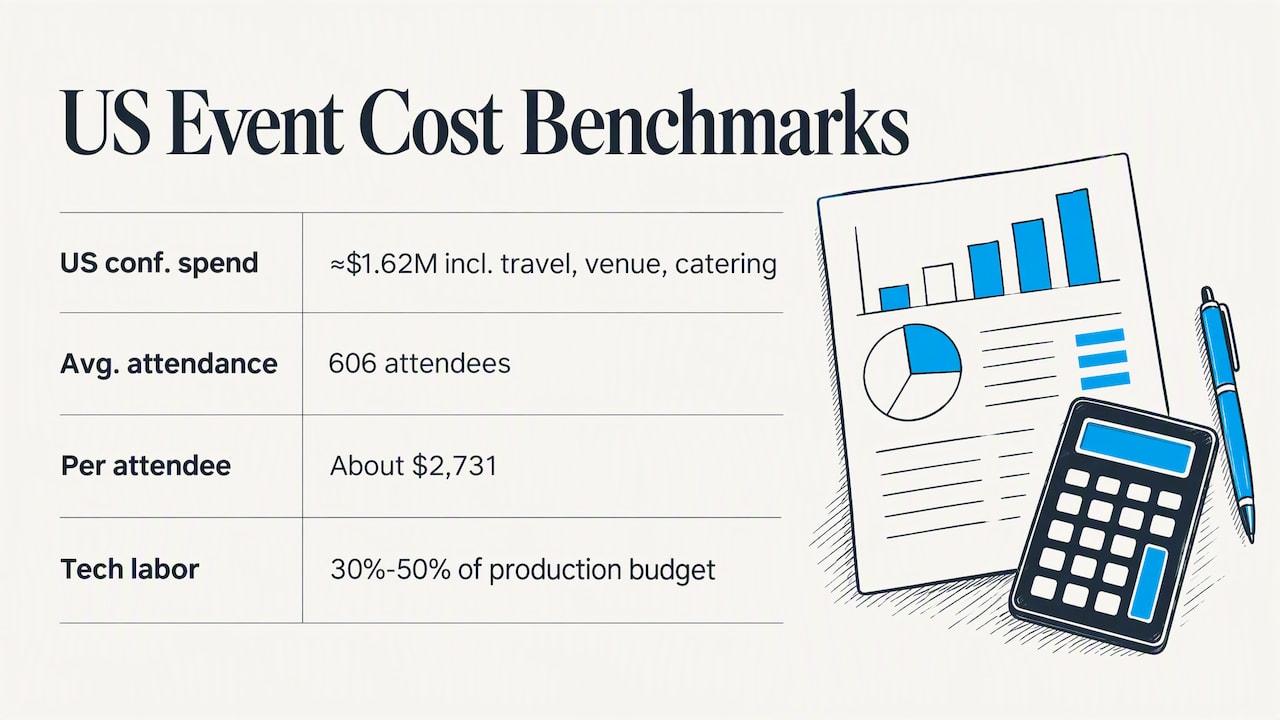
Benchmarks. One 2025 to 2026 analysis reports that professionally managed US corporate conferences averaged roughly $1.62 million in total spend for 606 attendees, about $2,731 per attendee. That figure covers the whole conference, including travel, venue and catering, so it is not a production price. The same source describes production as largely a fixed-cost line driven by venue scale and technical complexity rather than a purely per-attendee cost. In other words, adding 20 guests rarely changes the production bill. Changing the room, adding a stage or building a bigger screen does.
Labor. Another 2025 to 2026 industry report estimates that technical labor, meaning audio engineers, lighting designers and stage managers, generally accounts for 30% to 50% of the production budget. Skilled people are a large part of what you are paying for, which is a reason to be wary of quotes that look very cheap.
Market pressure. PCMA reported that AV costs have been affected by rising equipment, technician travel and trucking costs, along with staffing shortages. Ask for quotes with an expiry date and book early.
What changes your quote
- Room size and ceiling height. Bigger rooms need more speakers, more light and larger screens.
- Number of program segments. A single keynote is simple. A show with video, live music, awards and a dance set needs more crew and more cueing.
- Design ambition. Custom DJ booths, LED walls and lighting effects take design and build time.
- Load-in conditions. Stairs, tight docks, overnight builds and union rules add hours.
- Crew hours. Rehearsal time and a long strike affect labor.
- Documentation. Photo and video coverage, and same-night edits, are separate scope lines.
How to keep the budget sensible
Set the goal first, then rank the elements: the three things guests must see and hear, and the extras that are nice to have. Ask us to price those as options. That gives you a base package and add-ons rather than one number to accept or reject.
How to make a corporate event more engaging
Production choices shape attention. The IAEE piece above describes production partners contributing to the attendee experience and brand strategy, not only equipment delivery. Practical ways to apply that:
- Open strong. Walk-in music, lighting that signals the start, and an MC who sets the energy in the first two minutes.
- Keep transitions tight. Dead air between segments is where phones come out. Cue music and lighting changes to the program.
- Make the brand visible without shouting. Logo projection, color-matched lighting and screen loops do this better than banners.
- Give people something to do. A photo booth with a branded template, a testimonial booth or an interactive element gives guests content to share.
- Plan the second half. After dinner and awards, a well-run music set keeps people for networking instead of heading for the coat check.
- Match the tone to the audience. A sales kickoff, a client dinner and a family-friendly company picnic need different energy.
Our perspective: production is part of the message
We have produced events for more than 20 years, and one belief has held up through all of them: guests judge a company by how its event feels. Muddy sound, a slow program or a flat room reads as carelessness, whatever the CEO says on stage. A polished, well-timed room reads as competence.
That is why we do not treat entertainment and technical production as separate purchases. Our team designs the room, the lighting, the screens and the music together, so the DJ, the lighting designer and the video crew work from one plan. Our exclusive Piano DJ Booth is a good example: it gives a corporate gala an instantly memorable focal point and makes the music part of the decor.
We also build around the people in the room. Our DJs and MCs include bilingual and international talent, which matters for companies with multilingual teams, global clients or guests from different cultures. We tailor events to the style and culture of the people hosting them, and we serve clients in New Jersey, New York and internationally.
If you are choosing between a package that lists equipment and a partner who asks about your audience first, pick the second. The equipment follows from the answers.
— LJDJS
Work with LJDJS on your next corporate event
We design and produce corporate functions, from client dinners and galas to holiday parties and milestone celebrations. That includes DJ and MC entertainment, lighting, LED screens and video walls, photo and video coverage, and specialty acts, planned together. Start with our production page to see what we can build, or tell us about your event through LJDJS and we will scope it with you.
How to choose a corporate event production partner
Use these criteria when you compare proposals. They hold whoever you hire.
- Relevant experience. Ask for examples of events like yours in size and format. Watch their videos, and see ours on our videos page.
- A named show-day lead. You should know who is in charge when something goes wrong.
- Scope in writing. Equipment lists, crew counts, hours, load-in and strike times, and what happens if the schedule slips.
- Backup plans. Spare microphones, redundant playback, and a plan for a power or network failure.
- Venue knowledge. A team that has worked in your venue, or will visit, avoids surprises.
- Design sense. Look at how the room looks and feels, not only the equipment.
- One point of contact. Fewer handoffs mean fewer errors.
- Cultural and language fit. If your audience is multilingual, ask whether the MC and DJ can serve it.
Mistakes that cost corporate clients
- Booking production after the venue without checking technical limits.
- Leaving presentations until the day before.
- Skipping a rehearsal with speakers.
- Treating entertainment as an afterthought instead of part of the run of show.
- Choosing on the lowest quote without comparing crew hours and backup gear.
FAQ
What does an event production company do?
It designs and delivers the technical and creative parts of an event: sound, lighting, video, staging, entertainment and show-day management. Some also handle venue selection, catering and logistics, which Cvent includes in its definition of production. The scope should be written in your proposal.
What is the difference between event management and event production?
Event management covers strategy, planning, logistics and administration. Event production delivers the technical and creative elements that bring the concept to life, as Eventbrite’s guide explains. Many corporate events use both, sometimes from the same company.
What is the average cost per person for a corporate event?
It varies widely. One 2025 to 2026 analysis put US professionally managed conferences at about $2,731 per attendee all in, but that includes travel, venue and catering. Production itself depends more on room size and technical complexity than headcount, so request a quote for your specific event.
How far ahead should I book production?
As early as the date and venue are set. Large galas and conferences can need many months of lead time, and equipment and crews are limited in busy seasons. For a smaller dinner or party, a few weeks may work, but earlier gives you more design options.
How do you emcee a corporate event?
Prepare a run of show, learn the names and titles you will announce, keep introductions short and cue every transition. A professional MC also manages timing quietly and adapts to delays. We provide experienced MCs, including bilingual hosts, for corporate events.
Sources
- Event Production Guide, Cvent Blog
- Event Production: Getting Started Today, Eventbrite
- Say Hello To Your New Best Friend, The Official Services Contractor, IAEE
- Navigating Rising AV Costs for Events, PCMA
- How Much Does Hosting a Conference Cost in 2026?
- Event Management Industry Staff Costs 2026, Stealth Agents
- Event Planning Timeline: 5 Phases From 12 Months Out to Event Day, Lyyti
Pingback: LED Video Wall Rental Cost: What You’ll Actually Pay in 2026 – LJDJs Event Design & Entertainment
Pingback: Corporate Event Entertainment in New York: How to Choose – LJDJs Event Design & Entertainment