Event design services shape how an event looks, sounds and feels: the lighting, layout, decor, staging, music and visual effects, all built around one concept and the people attending. Event planning handles logistics. Design handles the experience. The best results come when both work from the same goals, and when the design team covers entertainment and production, not just decor. This guide explains what is included, how the process runs, what to settle before you sign, and what moves the budget.
TL;DR
- Event design is the creative side of an event: atmosphere, lighting, decor, staging, sound and entertainment working as one concept. Planning is the logistics side.
- Good design starts with the event’s goal and its audience, then turns them into specific choices that stay consistent from the invitation to the last song.
- Before you hire, settle the mood, palette, branding rules, technical needs and music licensing.
- Budgets in the U.S. are shaped by scale, food and beverage, audio/visual and material costs, so ask for a line-by-line scope.
- We design and produce celebrations and corporate events in New Jersey, New York and beyond, with DJ booths, LED walls, lighting and in-house photo and video.
Table of Contents
- What event design services include
- Event design vs. event planning
- How design turns goals and audience into one experience
- How décor, lighting, staging and entertainment work together
- How design is personalized for weddings, corporate events and milestones
- What to clarify before you hire a designer
- What happens from first consultation to event day
- What shapes an event design budget in the U.S.
- How to choose an event design company
- Our perspective
- Plan your event design with LJDJS
- FAQ
- Sources
What event design services include
Event design is the process of planning and creating the aesthetic and experiential elements of an event so they line up with its theme, objectives and brand. vFairs describes it as covering the physical layout, color schemes, lighting, sound and interactive features working together. That definition is a useful checklist, because it shows how much sits outside “decor.”
In practice, a full-service design scope usually touches these areas:
- Concept and theme. The central idea, color palette and visual references that every other choice answers to.
- Space and layout. Where guests arrive, eat, dance, take photos and rest, and how they move between those spots.
- Lighting. Ambient washes, uplighting, moving lights, and projected graphics such as monograms.
- Staging and focal points. DJ booths, stages, backdrops, screens and feature walls.
- Sound and music. The DJ or band, the MC, and the audio system that carries them.
- Visual media. LED video walls, screens, photo and video coverage.
- Guest interaction. Photo booths, crowd motivators, specialty acts and effects that give people something to do and remember.
A company that offers only one of these is a vendor. A company that treats them as one system is a designer. The difference shows on event day, when a dance floor that is lit well, sounds right and has a clear focal point gets used, and one where each element was bought separately often does not.
Event design vs. event planning
People use the two terms interchangeably, and many companies do both. They are still different jobs. Eventbrite frames it simply: planning is the strategic organization and management of logistics, such as setting dates, choosing venues, building vendor relationships, creating a budget and organizing speakers. Design is the creative process of choosing lighting, furniture and decor to build a striking visual and atmospheric experience.
| Event planning | Event design | |
|---|---|---|
| Main question | How does this run smoothly? | How should this feel and look? |
| Typical tasks | Date, venue, vendors, budget, schedule | Concept, lighting, decor, staging, entertainment |
| Output | A working plan and timeline | A cohesive guest experience |
| Who benefits most | Anyone with a complex logistical load | Anyone who wants the event to feel distinct |
You can hire a planner and a designer separately, or one team for both. If you already have a planner or venue coordinator, a design and entertainment company can slot in under them. Event planners who bring us in for the creative layer get a partner who handles the production details of that layer, from booth to lighting to sound.
How design turns goals and audience into one experience
The most common design mistake is starting with Pinterest boards instead of purpose. Cvent advises establishing the event goal first, then knowing the target audience before developing the event flow, so each decision matches the event’s purpose and the audience’s expectations.
That sounds abstract until you translate it. Here is how the same question plays out for three events:
- A wedding for 150 guests with two families and two languages. The goal is that both sides feel at home. Design decisions: music that moves between languages and generations, an MC who can address everyone, a dance floor lit warmly enough for grandparents to step onto it.
- A product launch for a sales team. The goal is energy and message retention. Design decisions: a stage and screens that put the brand front and center, lighting cues tied to announcements, a short run of show.
- A Sweet 16 or Quinceañera. The goal is a moment of celebration for the honoree and a night the guests talk about. Design decisions: a grand entrance, a visual identity that feels like the honoree, interactive elements for teens and relatives alike.
A second principle is consistency. Eventbrite stresses that each design decision should serve the event goals and appeal to the target audience, and that consistency across touchpoints helps tell one story. Practically, the monogram on the dance floor, the color of the uplighting, the invitation suite and the photo booth backdrop should look like they belong to the same family.
AhaSlides breaks a designer’s thinking into five dimensions that run at once: visual environment, physical layout, sensory atmosphere, attendee journey and programming. IBM’s own event design guidance makes a similar point at corporate scale, saying programming defines the experiences needed to support the narrative, such as activations, presentation zones and networking spaces. The vocabulary changes between a wedding and a conference. The logic does not.
How décor, lighting, staging and entertainment work together
Cvent describes event design as creating an overall concept and aesthetic that captures attention and enhances ambience, with visuals, audio and experience woven together. Here is what that looks like when the elements are planned as a group.
Lighting sets the room before anyone speaks
Lighting is the fastest way to change a room. Wireless uplighting washes walls in your palette without cables across the floor. Intelligent lighting adds movement and color changes that follow the music. Monogram projection puts initials, a logo or a custom graphic on the floor or wall. Our wedding gobo lighting guide covers monograms, placement and planning in detail.
Staging gives the room a focal point
Every event needs a place the eye goes. For us that is often the DJ booth. Our Piano DJ Booth and Chandelier DJ Booth are designed to turn the entertainment position into part of the decor rather than a folding table in the corner. Custom LED video walls do the same job for corporate stages and large celebrations, carrying motion graphics, live camera feeds or a slideshow. If you are weighing that choice, our page on LED video wall rental cost explains what drives the price.
Entertainment drives the energy
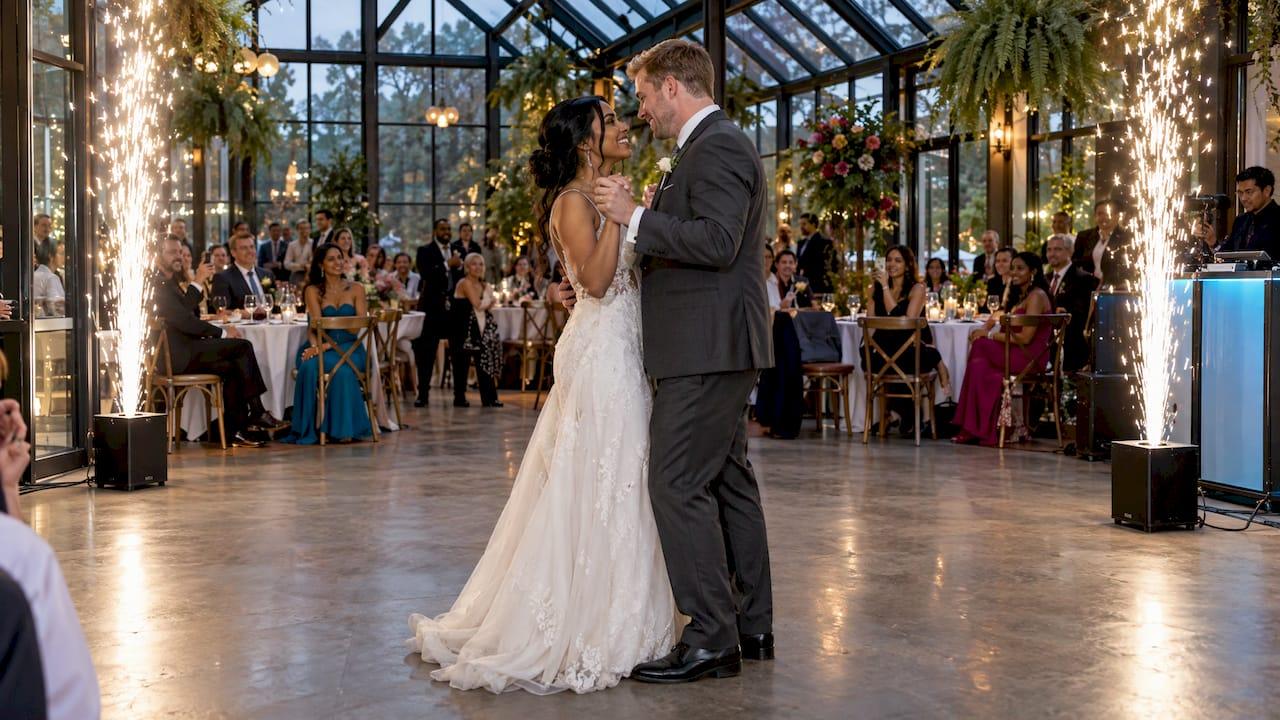
A DJ and MC who read the room do more for a party than any centerpiece. Bilingual and international DJs matter when guests speak different languages. Musicians, specialty acts and crowd motivators add moments that break up the night. Effects such as indoor cold sparklers and an indoor snow effect create short, photographable peaks, best timed to a first dance, an entrance or a cake cutting.
Capture ties it together
Photo and video coverage records the design and also becomes part of it, through classic and video testimonial photo booths. Our photography and videography team works inside the same event, so the camera crew already knows where the light and the moments will be.
Audio visual is the part guests only notice when it fails
Sound, screens and projection need to be specified with the room in mind. Our guide to event audio visual services explains what they include and how to book them.
How design is personalized for weddings, corporate events and milestones
Personalization is more than a name on a sign. It means the design reflects the people in the room, their taste and their culture.
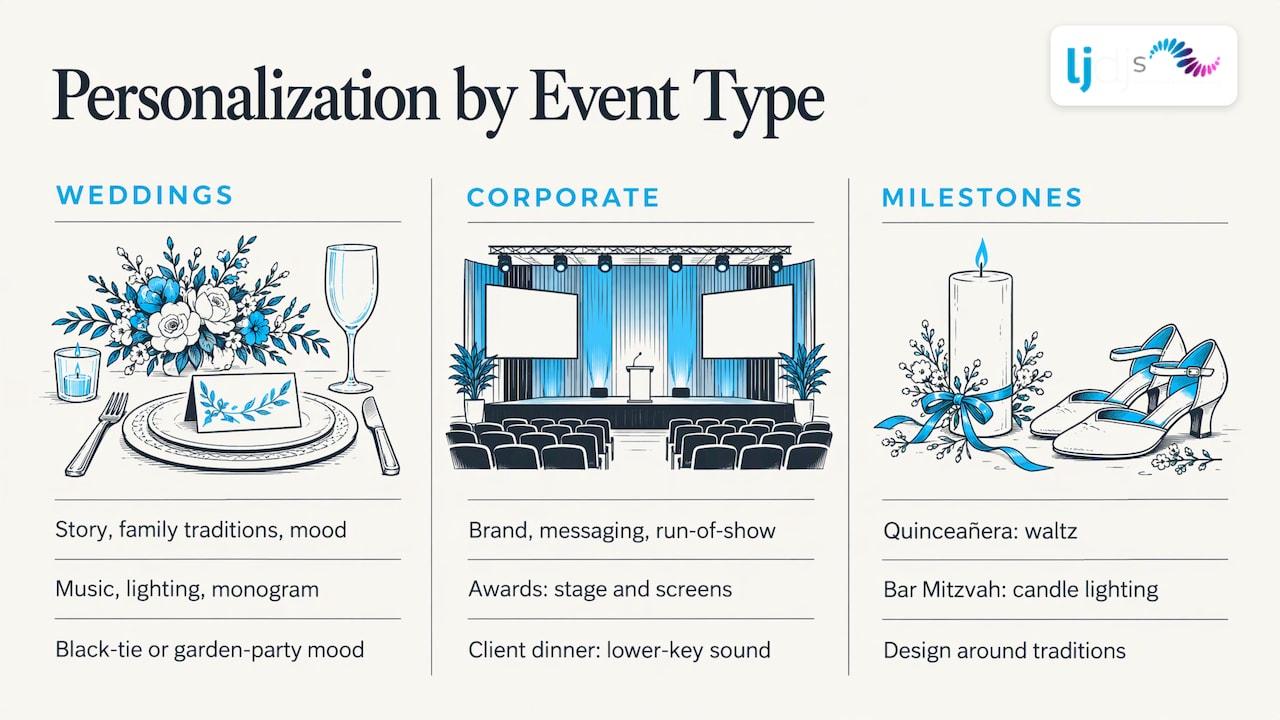
Weddings. The questions are about the couple’s story, the families’ traditions and the mood. Do you want a black-tie dinner that turns into a club at 10 p.m., or a garden party feel all night? Music, lighting and a monogram reflect those answers. See our wedding entertainment page for what we offer.
Corporate events. Brand guidelines, executive messaging and run-of-show timing lead. The design has to serve the agenda: an awards night wants a stage and screens, a holiday party wants a dance floor and a photo moment, a client dinner wants a lower-key sound. If you plan events in the New York area, our guide on corporate event entertainment in New York and our overview of corporate event production go deeper. Even the bar can carry the theme: ideas for branded cocktails for corporate events show how drinks can echo a company’s colors and message.
Milestone celebrations. Sweet 16s, Quinceañeras and Bar and Bat Mitzvahs carry specific traditions, from a Quinceañera waltz to a Bar Mitzvah candle lighting and hora. A designer who understands these moments builds the lighting, music and staging around them. Details are on our Sweet 16 and Quinceañera and Bar and Bat Mitzvah pages, and our Bar Mitzvah DJ guide helps with choosing one.
What to clarify before you hire a designer
A clear brief saves more money than any discount. LegalClarity’s client questionnaire guidance lists the areas to cover, and they translate well to any personalized event design.
- Atmosphere. Write three words for how guests should feel when they walk in. “Elegant, warm, lively” gives a designer more than “nice.”
- Palette and references. Bring images, fabric swatches, logos or a mood board. Mark what you do not like as well.
- Branding rules. For corporate events, share logo usage guidelines, required slogans and any restrictions on partner or sponsor branding.
- Technical needs. Stage or podium, screens, audio, specialty lighting, power and rigging access. Ask the venue about load-in times and ceiling height.
- Entertainment details. Music style, must-play and do-not-play lists, language needs, MC duties and special moments.
- Music licensing. The same guidance notes that playing copyrighted music can count as a public performance and may require licensing. Venues often hold the relevant licenses, so confirm with yours.
If you have a planner or venue coordinator, share the brief with them too, so one timeline holds everything.
What happens from first consultation to event day
Every company runs its own process, but a well-run design engagement tends to follow the same arc:
- Discovery call. You describe the event, the guest count, the venue, the date and what you want people to feel.
- Concept and scope. The designer proposes a look and a list of elements: booth, lighting, screens, entertainment, photo and video. You react, and the concept is refined.
- Venue check. The team reviews the floor plan, power, load-in access and sound limits, either in person or from venue documents.
- Details and timeline. Music preferences, announcements, family introductions, special dances and the run of show are written down and shared with every vendor.
- Final confirmation. A last review of counts, timing and any changes, usually close to the event date.
- Setup and event day. The crew loads in, builds and tests lighting, audio and visuals before guests arrive, then the DJ and MC run the night against the timeline.
- Wrap. Teardown, and delivery of photos or video if they are part of the package.
Ask any designer how they handle each step and who your contact will be on the day. For specifics on how we work, start from our event design and entertainment page.
What shapes an event design budget in the U.S.
Event design is priced by scope, not by a single rate, so published prices are rare and quotes vary. Several factors move the number.
- Guest count and event length. More guests mean more space to light, more audio coverage and more food and drink.
- Venue. A blank-slate ballroom needs more design than a venue with built-in character. Union rules, load-in restrictions and power limits add cost in some city venues.
- Number of elements. A DJ with uplighting is a different scope from a custom LED video wall, a specialty act, indoor effects and a live musician.
- Food and beverage and AV. In a GoGather 2025 benchmark of managed U.S. conferences, food and beverage took 32.5% of the budget and audio/visual 19%. Those are conference numbers, not wedding numbers, but they show that AV is a major line, not an afterthought.
- Materials and timing. Event professionals have reported that tariff-driven price changes have pushed many to add contingencies and to source locally where they can. Booking earlier and locking scope gives you more control.
To compare quotes fairly, ask each company for the same list: every element, hours of coverage, setup and teardown time, crew size and what is not included. Our guides to corporate event production costs and LED video wall rental cost show how we break those items out. We do not publish package prices, because the right scope depends on your room and your guests.
How to choose an event design company
Use criteria that predict how your event will feel, not just what the website looks like.
- One team across the elements. Fewer handoffs between DJ, lighting, video and photo means fewer gaps.
- Experience with your event type. A wedding, a corporate gala and a Quinceañera each have a rhythm. Ask for examples and videos of events like yours. Ours are on our videos page.
- Cultural fluency. If your guests speak more than one language or your event follows traditions, you want an MC and DJ who know them.
- Equipment they own and operate. It affects reliability and how much customization is possible.
- Clear communication. You should know who answers your calls and who runs the room on the night.
- A designed brief, not a catalog. Look for someone who asks about your goals before they mention products.
Our perspective
We have spent more than 20 years watching what makes a celebration work, and it is rarely the most expensive thing in the room. It is the feeling that every detail was chosen on purpose, for these people.
That is why we design and entertain under one roof. When the person who builds the lighting plan also knows the music, the timeline and the family dynamics, the dance floor fills earlier and the speeches land better. A booth that looks like part of the room, a monogram that matches the palette, an MC who can speak to both sides of a family: these are design decisions, not add-ons.
Our Piano DJ Booth and LED video walls exist because we wanted the entertainment position to become a centerpiece instead of an equipment corner. Our bilingual and international DJs exist because celebrations are rarely monolingual. And our in-house photo and video team exists because the design should be captured the way it was imagined.
If you are choosing a design partner, pick the one who starts by asking who is coming and what you want them to remember.
LJDJS
Plan your event design with LJDJS
We are an event design and entertainment company serving New Jersey, New York and clients internationally. Our services cover wedding, corporate, Sweet 16, Quinceañera and Bar and Bat Mitzvah entertainment, plus production, lighting, LED video walls, photo booths, musicians, specialty acts and in-house photography and videography.
Tell us the date, the venue and what you want your guests to feel, and we will shape the design and entertainment around it. Start at LJDJS event design and entertainment, or go straight to wedding entertainment or production. You can also browse the full list of lighting, screens and effects.
FAQ
What is the difference between an event designer and an event planner?
A planner manages logistics: dates, venues, vendors, budgets and schedules. A designer creates the look and atmosphere: concept, lighting, decor, staging and entertainment. Many events benefit from both, and some companies offer both under one roof.
When should I book event design services?
Book as soon as you have a date and venue, because popular dates fill and design choices such as custom booths, video walls and effects need lead time. There is no universal deadline, so ask your designer how far ahead they recommend for your season and event type.
How much do event design services cost?
There is no standard price, because cost follows guest count, venue, hours and the number of elements. Guest count and AV needs are the biggest drivers. Ask for an itemized quote, and see our guide to LED video wall rental cost for one example of how a single element is priced.
Can event design be personalized for different cultures?
Yes, and it should be. Music, language, ceremonial moments and visual style can all reflect your family’s or company’s culture. Tell your designer about traditions early so the timeline and the lighting can be built around them.
Do I need a music license for my event?
Playing copyrighted music in public can count as a public performance, which may require licensing, according to LegalClarity’s event guidance. Venues often hold licenses that cover their space, so confirm with your venue and your entertainment provider.
Sources
- Event Design: Craft Memorable Experiences, Eventbrite
- What is Event Design? vFairs
- Event Designing: A Guide to Perfect Your Next Event, Cvent
- IBM Event Design Foundation
- Event designing 101, AhaSlides
- Event Planning Questionnaire: Questions to Ask Clients, LegalClarity
- Tariffs Update: Event Execs Talk Business Impact, Event Marketer
- How Much Does Hosting a Conference Cost in 2026?
Pingback: Dance Floor Lighting: Layers, Placement and Planning – LJDJs Event Design & Entertainment