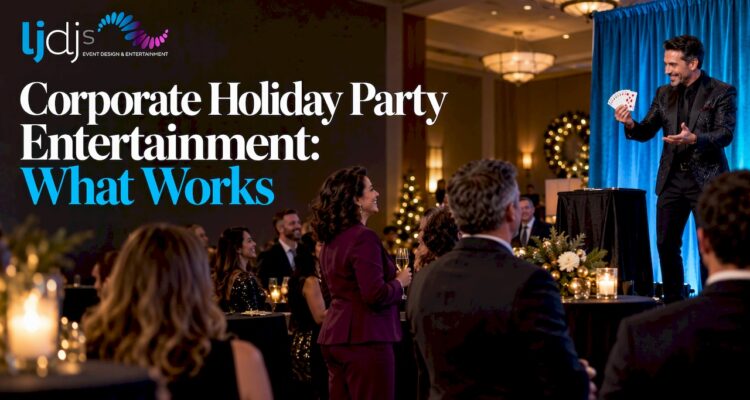
The best corporate holiday party entertainment is one professional host who reads the room, plays music your whole staff will dance to, and adds a few interactive pieces: a photo or video booth, a game, lighting that changes the room. A DJ and MC at the center, with two or three well-chosen extras, beats a long list of separate acts. It keeps the evening moving, suits a mixed-age workforce and leaves one team accountable for how the night feels. At LJDJS we build corporate evenings this way, with DJs and MCs, production, lighting and photo or video experiences planned together.
This guide covers the formats that work, how to match them to your people and your room, when to book, what drives the price and how to avoid the mistakes that sink a company party.
TL;DR
- Anchor the night with a DJ and MC, then add two or three interactive extras such as a photo booth, a game or a feature lighting look.
- Choose for your guests first: age range, languages, culture, how well people know each other and whether the party is a thank-you or a client event.
- Plan for the whole room: dance floor, a place for speeches, sightlines for screens, power and sound, not only seated capacity.
- Settle budget and headcount first, then book entertainment early in the fall, because December weekends go first.
- Price depends on hours, headcount, equipment and the number of performers, so ask for a written quote covering all of it.
Table of Contents
- What kinds of entertainment work for a company holiday party
- Get people involved instead of just watching
- Choose for your guests, not for the trend
- Plan the room, the sound and the screens
- When to book
- What affects the price
- Mistakes that flatten a company party
- Our perspective
- Plan your party with one team
- FAQ
- Sources
What kinds of entertainment work for a company holiday party
The usual options fall into a few types. Each solves a different problem.
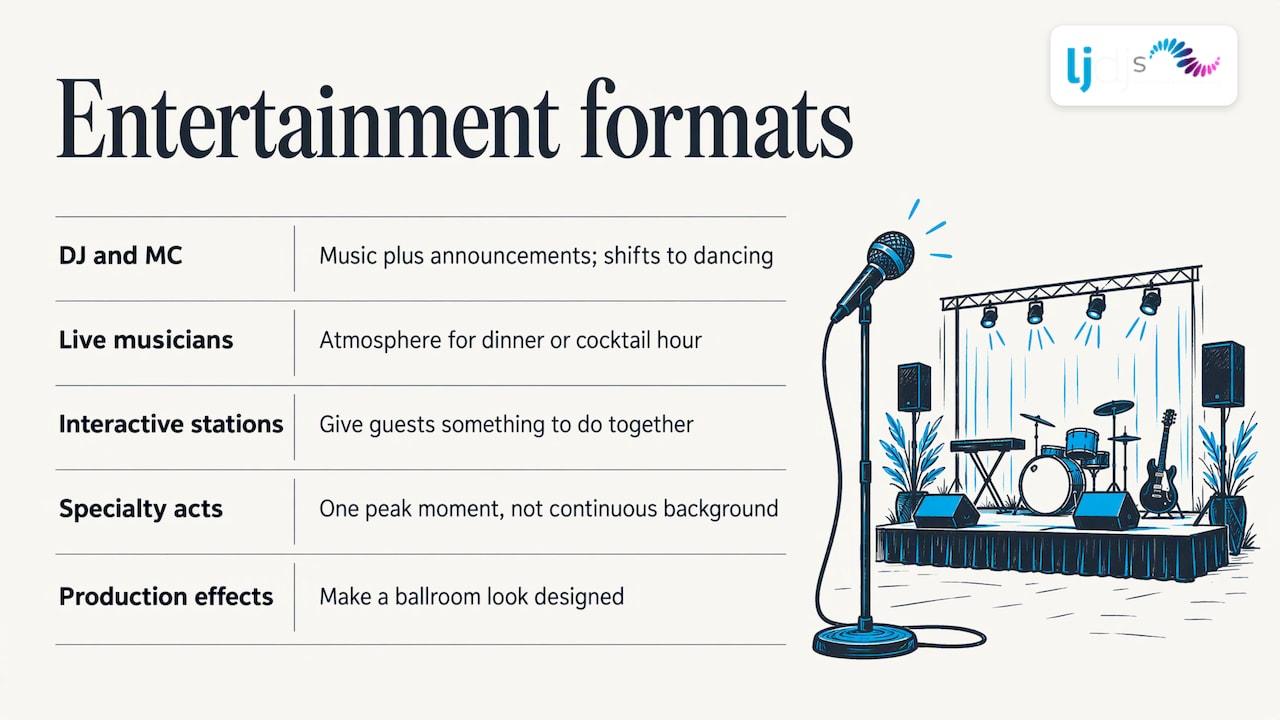
DJ and MC. A DJ plays the music; an MC (master of ceremonies) runs the microphone moments: welcome, awards, toasts, raffle, buffet release. This pairing carries the entire evening and handles the shift from dinner to dancing. It is the most flexible choice because the playlist can follow the crowd, from holiday classics to current hits to Latin, Bollywood or Top 40 for a multicultural office.
Live band or live musicians. Strong for a formal dinner or a cocktail hour. A soloist, duo or small ensemble on strings, sax or piano gives the room atmosphere without dominating conversation. A full band suits a large dance-focused party but takes more stage space and power.
Interactive stations. Photo booths, video booths, games and craft or tasting tables give people something to do with a coworker they rarely see. They work well in the first hour, when guests are arriving and the dance floor is empty.
Specialty acts. Dancers, aerialists, magicians, comedians and similar performers create a moment people talk about on Monday. They are best used once, as a peak, not as continuous background.
Production effects. Lighting, LED screens, monograms and effects like cold sparklers or indoor snow make a hotel ballroom look designed rather than rented. This is the part guests photograph.
The pages that rank for this keyword list many of these, from comedians to live bands to games. The list is not the hard part. The hard part is deciding which three belong at your party.
Get people involved instead of just watching
An office party fails quietly when entertainment is something done to the guests. Employees stand along the walls, watch a performer and leave early. Participation changes that.
Employee-focused guides recommend activities that give people a reason to talk. Greenvelope’s 2026 guide suggests holiday trivia, Name That Tune, station-style games and scavenger hunts, with karaoke and song requests adding participation around the dance portion. The same guide notes that hands-on activities create conversation opportunities, and that the format should scale with the party: a 300-person event calls for several rotating stations, while a 30-person party can run on one trivia round and one game table.
Here is how that translates into a run-of-show:
- Arrival hour: a photo or video booth and one casual game. People mingle without needing to perform.
- Dinner: low-volume music and an MC who keeps announcements short.
- Program: awards, toasts or a raffle, with a screen showing a team slideshow or the company year in review.
- Dance set: the DJ opens with songs the whole room knows, then builds. A crowd-motivating host helps shy groups warm up.
- Final stretch: one memorable moment, such as an effect, a specialty act or a group song, so the night ends high.
A video testimonial booth is worth considering when the party doubles as a culture moment. Colleagues record short thank-yous or highlights of the year, and HR or marketing gets usable content. We explain how that format works in our guide to the video testimonial booth, and our video photo booth page covers the formats for guests who simply want a fun keepsake.
Choose for your guests, not for the trend
Before you pick anything, answer five questions.
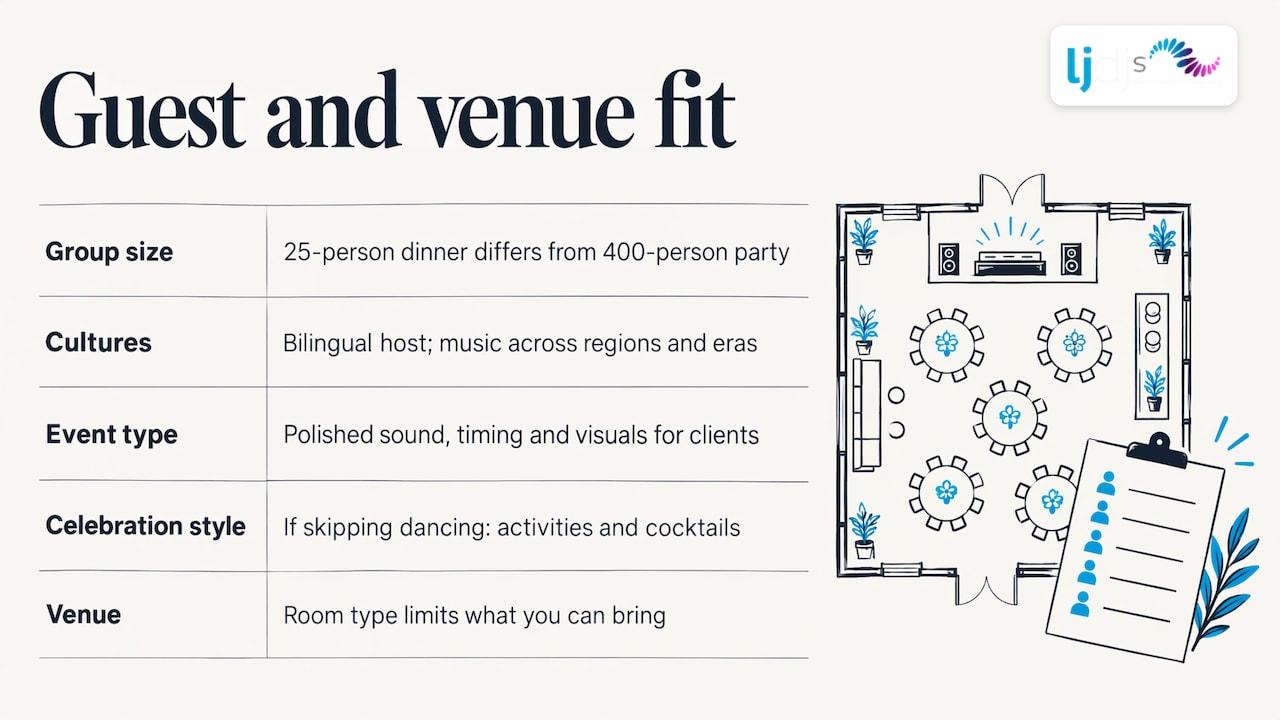
Who is in the room? A 25-person team dinner and a 400-person all-company party need different formats. Count partners and plus-ones too: a dance-heavy night that suits 28-year-olds may leave senior staff and spouses at their tables.
What languages and cultures are represented? In a diverse workforce, music is the fastest way to make people feel included. We work with bilingual and international DJs and MCs, so the host can greet guests and run the program in more than one language, and the music can move through different regions and eras without feeling like a gimmick. This is particularly useful for New York and New Jersey companies, where a single office can span many backgrounds.
Is it a thank-you or a client event? A staff party can be loud and playful. A client appreciation evening needs polish: conversation-friendly sound levels early, tight timing and refined visuals.
How do your people actually celebrate? If your company skips the dance floor every year, build the night around activities and a strong cocktail atmosphere, and let the DJ keep it moving rather than forcing a dance party. If your team loves to dance, give them space and a real sound and lighting setup.
What is the venue like? A restaurant private room, a hotel ballroom and a loft each limit what you can bring. That leads to the next section.
For New York companies, our guide on how to choose corporate event entertainment in New York goes deeper on matching entertainment to the city’s venues.
Plan the room, the sound and the screens
Book entertainment against the room, not just the headcount. GreatEvent’s venue guide points out that setup should account for dance-floor space, entertainment, a presentation stage, accessibility, coat check and AV technology, not only seated capacity. Companies that skip this step end up with a dance floor the size of a bathmat and a DJ next to the buffet.
A practical checklist:
- Dance floor: leave clear space in addition to your tables. Place it away from the coat check and the entrance so traffic does not cut through it.
- Stage or speaking area: decide where the CEO speaks and where awards happen, and make sure everyone can see it.
- Screens: for slideshows, live video or sponsor logos, a screen is more reliable than a projector in a bright ballroom. Our LED video wall rental cost guide explains what drives that line item, and our event audio visual services guide shows what a full AV package includes.
- Power and load-in: ask the venue about load-in times, elevator access, union or house rules and power capacity before you sign with anyone.
- Lighting: uplighting and moving lights change a room’s mood in minutes and give you the dance-floor look without redecorating. See dance floor lighting: layers, placement and planning for how the layers work together.
- Guest comfort: tell guests what to expect. A note about dress and a dance floor helps, and dance-friendly outfit formulas are a handy reference for people deciding what to wear to a party where they plan to move.
If you want the whole room to look designed rather than assembled from rentals, our corporate event design guide walks through lighting, staging and branding together.
When to book
Holiday dates are a seasonal squeeze. Invyt’s 2026 planning checklist for parties of 50 to 300 people sets budget and headcount in August, secures the venue and date in late August and books entertainment in September. That is a sensible order: entertainment depends on a confirmed room and date.
The pattern to follow each year:
- Late summer: set the budget, estimate headcount and shortlist venues.
- Early fall: lock the venue and book the DJ, MC and any production or specialty acts. Peak December Fridays and Saturdays are the first to go.
- Four to six weeks out: confirm the run-of-show, music preferences, any do-not-play list, languages and the program timing.
- One week out: confirm load-in, headcount and who the day-of contact is.
If you are reading this later in the season, reach out anyway, and consider a weeknight or a less obvious date. A Thursday evening or an early-December weekday party often has more availability and can feel just as festive.
What affects the price
Corporate holiday entertainment is priced to the event, not from a rate card, so any honest number depends on a handful of variables:
- Hours of entertainment and whether setup, a cocktail hour and a dance set are all included.
- Headcount, which drives sound, lighting and how many stations you need.
- Equipment and production: a basic sound system costs less than screens, intelligent lighting and a custom stage look.
- Number of performers: a DJ alone, a DJ with an MC, or a DJ with musicians and a specialty act.
- Extras: photo or video booths, monograms, photography and videography.
- Date and location: peak December dates and travel into a city venue affect both availability and cost.
Our offers do not carry published prices, because the right package depends on these factors. A useful way to budget is to decide what share of the total you want entertainment to take after venue and catering are set, then ask for a written quote that lists hours, equipment, staff and extras line by line. Our corporate event production guide explains what production covers and what it costs, line by line.
Mistakes that flatten a company party
- Booking entertainment last. The venue and caterer are often fixed first, and entertainment gets whatever is left.
- Choosing for the executive team only. Pick for the full guest list.
- Too many acts. Three well-run elements outperform seven that compete for attention.
- No plan for the quiet first hour. An empty dance floor at 7 p.m. is normal. Give people stations or a booth.
- Unclear program. Awards, toasts and the raffle need an MC with a firm timeline, or the evening drags.
- Forgetting the camera. A party that is photographed or filmed becomes recruiting and culture content. See our guide to corporate event videography for planning that in advance.
Our perspective
Most company parties are not remembered for the headline act. They are remembered for whether people felt comfortable, whether the room looked special and whether the night had a shape.
That is why we start with a host and build outward. A DJ and MC who understand your team can read the room, move from dinner to dancing at the right moment and keep the program on time. From there, production adds the look: LED video walls, intelligent lighting, monograms and effects. Interactive pieces such as photo and video booths give people something to do and something to take home.
We have been designing events for over 25 years, and we treat a corporate party the same way we treat a wedding or a milestone celebration: it should reflect the people in it. Our bilingual and international DJs and MCs help multicultural teams feel included, and our in-house photography and videography capture the night without adding another vendor to coordinate.
If you want a centerpiece that guests talk about, our Piano DJ Booth and Chandelier DJ Booth turn the DJ position itself into part of the design.
LJDJS
Plan your party with one team
We handle corporate events in New Jersey and New York, and we also serve clients globally. Our team can combine a DJ and MC, bilingual hosts, lighting, LED screens, photo or video booths, live musicians, specialty acts and in-house photography and videography into a single plan for your date and room. If you are weighing a distinctive DJ setup, start with our Piano DJ Booth and Chandelier DJ Booth.
Tell us your headcount, venue and the feel you want, and we will shape the entertainment around it. Start at LJDJS event design and entertainment, or see the full list of production enhancements such as uplighting, LED screens, crowd motivators and cold sparklers.
FAQ
What is the best entertainment for a corporate holiday party?
A DJ and MC, supported by one or two interactive elements, suits most companies. The DJ adapts to a mixed-age, multicultural group, and the MC keeps awards and toasts on schedule. Add a photo or video booth and a feature lighting look for atmosphere.
How far ahead should we book?
Book right after you confirm the venue and date. Planning checklists for parties of 50 to 300 people place entertainment booking in September, and December Fridays and Saturdays are the first dates to go. Later bookings are often still possible, especially on weeknights.
How do we get employees who don’t dance involved?
Give them something else to do: a photo or video booth, trivia, a game station or a raffle with an MC. Keep the dance floor optional and the music at a level where people can still talk. Many guests join the dancing later once the room has warmed up.
What should we tell the entertainer before the party?
Share your headcount, the age range, the languages spoken, the program timing and any songs or topics to avoid. Also share the venue’s load-in rules and the contact person on the day. With that, the DJ and MC can plan music and announcements for your actual guests.
Sources
- Corporate Holiday Party Ideas for 2026, Greenvelope
- Corporate Holiday Party Venues (2026 Guide), GreatEvent
- Company Holiday Party Planning: 2026 Checklist, Invyt Blog