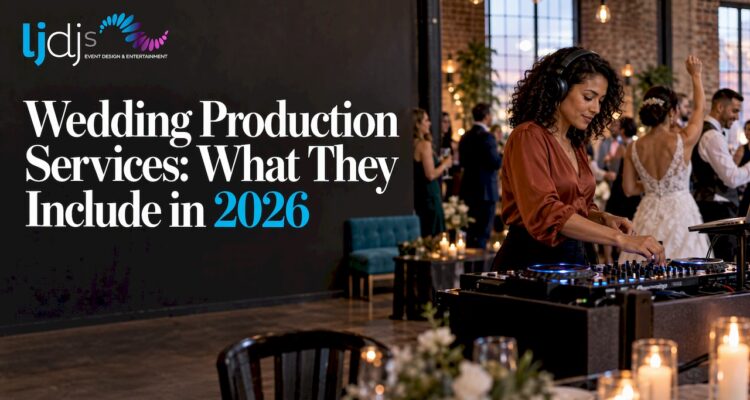
Wedding production services are the creative and technical side of your reception: the sound, lighting, video, effects, music and MC, all designed and run as one plan instead of hired as separate pieces. The simplest way to get that result is to book one team that designs and delivers the whole entertainment experience. At LJDJS, that means a DJ and MC, lighting, LED video walls, photo and video, and specialty acts planned together around your style and culture.
This guide explains what production covers, how it differs from planning, which elements you can combine, what drives the cost, and what to check with your venue before you sign anything.
TL;DR
- Production turns your wedding plan into what guests see and hear: design, audio, video and lighting, run to a timeline. Planning and coordination are a related but separate job.
- The elements combine: DJ and MC, uplighting, intelligent lighting, monograms, LED screens, photo booths, live musicians and specialty acts.
- A DJ alone is the baseline. Production adds equipment, design and staffing on top, so the price depends on what you stack.
- Your venue contract sets load-in times, sound limits and house rules. Settle them before you finalize any production plan.
- One team handling music, lighting, visuals and capture means fewer handoffs on the day.
Table of Contents
- What wedding production actually means
- Which elements you can combine
- How production is personalized
- What it costs, and why DJ-only prices mislead
- Coordinating production with your venue
- Building the timeline with your other vendors
- When production is worth adding
- Beyond weddings
- Plan your production with LJDJS
- FAQ
- Sources
What wedding production actually means
Event production is the work of bringing an event plan to life through creative and technical execution, including design, audio, video and lighting. Eventbrite’s event production overview draws the line this way: event management handles strategy and overall coordination, while production handles how the event looks, sounds and runs. It can also include sourcing suppliers, logistics and technical rehearsals.
For a wedding, translate that into what a guest experiences:
- How the room looks when the doors open: uplighting, monogram projection, screens.
- How the evening sounds: ceremony audio, toasts, dinner music, dance sets.
- How the night moves: announcements, the grand entrance, first dance, cake cutting, the shift from dinner to dancing.
- How it is captured: photos, video, and guest messages.
A wedding planner or day-of coordinator owns the schedule and the vendors. A production team owns the show inside that schedule. The two overlap at the timeline, which is why they should work from the same document. If you want to see where coordination ends and production begins, our guide to wedding day coordination walks through it.
Which elements you can combine
Production is modular. Couples rarely need everything; they choose the layers that fit the room and the crowd. Here is how the pieces usually stack.
The music and hosting layer
The foundation is the DJ and MC. The DJ reads the room and builds the dance floor; the MC keeps announcements clear and the timeline moving. For ceremonies, cocktail hours and dinner, you can add live musicians. If your families speak different languages or celebrate different traditions, bilingual and international DJs and MCs let the music and the announcements work for everyone in the room. Our page on wedding ceremony music covers order and timing for the ceremony itself.
For couples who want a centerpiece, our Piano DJ Booth and Chandelier DJ Booth turn the DJ position into part of the room’s design instead of a table in the corner.
The lighting and design layer
Lighting changes a room more per dollar than almost any other element. The common building blocks are:
- Wireless uplighting: color washes along the walls that match your palette, with no cables across the floor.
- Intelligent lighting: moving fixtures that shape the dance floor and shift with the energy of the night.
- Monograms: your initials or a custom design projected onto the floor or wall. See our guide to wedding gobo lighting for placement and planning.
- Pin spotting: focused light on centerpieces, the cake or the head table.
The visual and effects layer
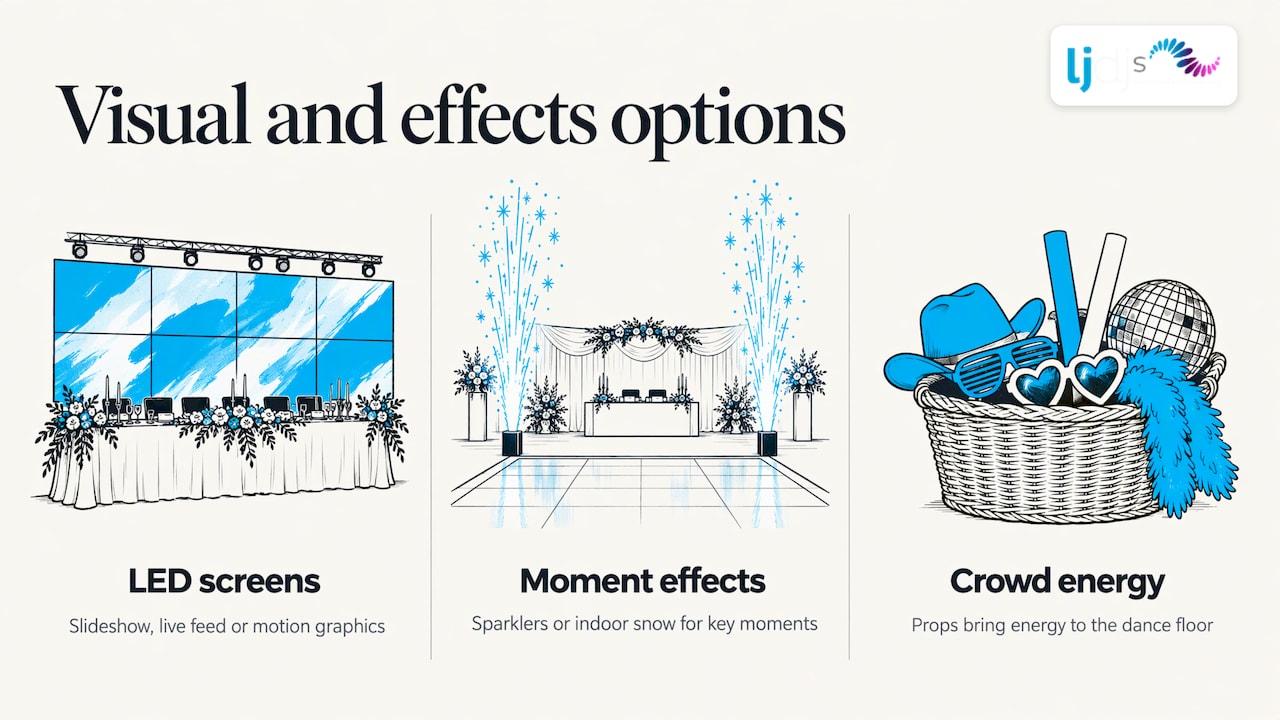
LED screens and custom LED video walls carry a slideshow, a live feed, a monogram or motion graphics behind the head table or the dance floor. If you are weighing one, our LED video wall rental cost guide explains what drives the price. Effects such as indoor cold sparklers and an indoor snow effect are built for moments: the first dance, the grand entrance, the last song. Crowd motivators bring props and energy to the dance floor.
The capture and guest-experience layer
In-house photography and videography keep the capture team in step with the lighting and the timeline, because they work from the same plan. Photo booths, including video photo booths and a video testimonial booth, give guests a place to leave a message you will actually want to watch later. RFID bands and specialty acts round out the options for couples who want something unexpected.
How production is personalized
Generic production is the same rig and the same run of show in every ballroom. Personal production starts from the couple. Which traditions are in the room? Which languages? What songs did your grandparents dance to, and what does your college crowd request? What colors, textures and venue architecture does the lighting have to work with?
At LJDJS, our approach is to tailor each event to the client’s style and culture, with bilingual and international DJs and MCs available for families who celebrate across languages. In practice, personalization shows up in small, specific places: a monogram that uses your own design, an announcement made in two languages, a lighting palette pulled from your florals, a set that moves from a cultural dance to current hits without a break in energy.
The same planning applies to other celebrations. A Sweet 16 or Quinceañera and a Bar or Bat Mitzvah each have their own traditions and moments that production should be built around.
What it costs, and why DJ-only prices mislead
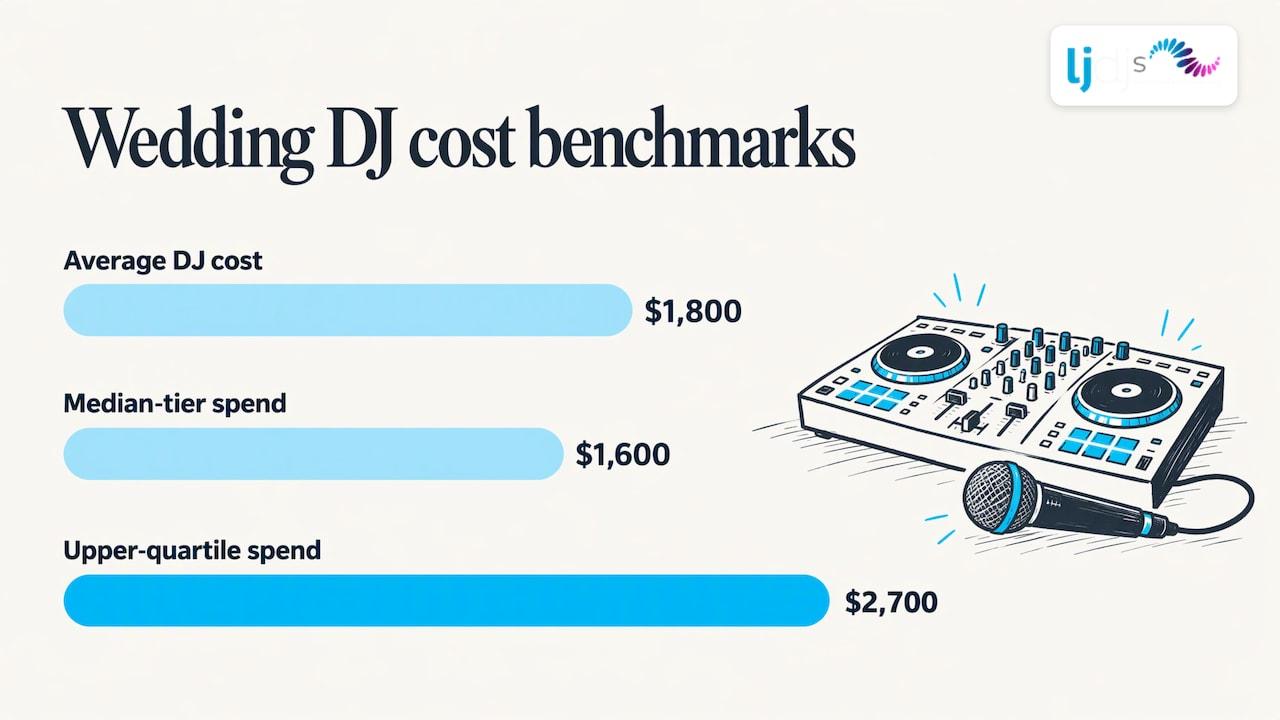
There is no single price for wedding production, because the price is the sum of what you choose. The best fixed point is the cost of the DJ itself. The Knot Real Weddings Study reports an average wedding DJ cost of $1,800, with a median-tier spend of $1,600 and an upper-quartile spend of $2,700. Those figures describe entertainment alone.
Production changes the equation in three ways:
- Equipment. Lighting, screens, effects and sound for a large room add gear, trucking and setup labor.
- Design time. Custom monograms, video content and lighting plans take planning hours before the day.
- Staffing. More equipment means more technicians, and a large ballroom needs a different crew than a backyard.
A useful way to budget is to price the baseline first (DJ and MC), then add layers in order of impact: lighting, then a visual element, then a moment effect, then capture. Our wedding DJ cost guide breaks down the baseline, and our New Jersey wedding DJ guide covers how it plays out in the tri-state market. Prices for production are quoted to the event, since they depend on the room, the guest count and the elements you pick.
Coordinating production with your venue
The fastest way to lose a design idea is to discover a venue rule after you have paid for it. Production touches power, ceiling height, load-in access and sound, and all of those are governed by your venue contract. A venue contract guide for engaged couples lists what to check: access and setup and cleanup times, vendor setup and takedown allowances, permitted spaces, included A/V and staffing, extra fees, vendor insurance requirements, and house rules such as sound limits, curfews, candles and wall attachments.
Turn that list into questions for each production element:
| Element | Ask the venue |
|---|---|
| DJ and sound | What is the sound limit and the music end time? Is there a separate ceremony and cocktail space? |
| Lighting and monograms | Can fixtures be rigged or placed on stands? Are there ceiling height or wall restrictions? |
| LED screens and video walls | Where can they be placed, and what power is available? |
| Effects (cold sparks, snow) | Are indoor effects allowed under the house rules? |
| Load-in and breakdown | When can vendors enter, and when must they be out? Is there a freight elevator or loading dock? |
| Insurance | Does the venue require a certificate of insurance from each vendor? |
Hotels and banquet halls often have in-house A/V and their own rules for outside vendors, and the way hotels present their wedding offerings varies. If you are comparing hotel venues, hotel wedding SEO gives a sense of how they position those programs, and it helps you know which questions to ask.
Once your venue answers, share the answers with your production team early. A site visit or a call with the venue’s event manager settles power, load-in and layout before the design is final.
Building the timeline with your other vendors
Production works best when it is written into the same run of show as everyone else. A good timeline names who is responsible for each cue: the planner or coordinator for the overall schedule, the photographer for the family formals, the caterer for service, and the DJ and MC for announcements, music and the dance floor.
The moments to align in advance:
- Ceremony to cocktail hour: audio handoff, who moves the speakers, and when the room flips.
- Grand entrance: the introduction order, the music cue and the lighting change.
- Dinner and toasts: microphone placement and the order of speakers.
- First dance and parent dances: the song edits, lighting look and any effect.
- Cake cutting and send-off: the cue for photo and video, and the final song.
With in-house photography and videography, the capture team and the entertainment team share the same plan, so cues for a first dance or an entrance do not have to be relayed between separate companies. Our Production team plans these cues with you and with your venue.
When production is worth adding
A modest backyard wedding with 40 guests may need a DJ, a speaker and a microphone. Production earns its place when one or more of these is true:
- The room is large, dark, or visually plain, and lighting would change how it feels.
- You have a mix of languages, generations or traditions to bring together.
- You want specific moments, such as an entrance, a first dance or a send-off, to feel staged.
- You want guest messages and video in addition to photos.
- You are hiring several vendors and would rather have fewer teams to coordinate.
If two or three of those are true, a production-led package usually makes more sense than a DJ with add-ons picked up piecemeal.
Beyond weddings
The same production model works for other events. Corporate clients can use screens, stage lighting, branded monograms and MCs to keep an audience engaged; see our guides to corporate event production, event audio visual services and event technology rental. Families planning milestone celebrations can borrow the same layers at a smaller scale, and event planners can bring us in as the entertainment and production partner for a full event design plan.
Our view on wedding production
After more than 25 years in event entertainment, we believe the best receptions feel effortless because nothing in them is accidental. The DJ, the lighting, the screens and the camera all follow one plan, and that plan starts with the couple’s story.
That is why we build around the couple’s style and culture first, and the equipment second. Our Piano DJ Booth, custom LED video walls, bilingual and international DJs and MCs, and specialty acts exist to serve that plan, not to fill a catalog.
We serve couples and families across New Jersey and New York, and we also work internationally. Whatever the room, the goal is the same: a celebration your guests describe as seamless and that you remember as yours.
LJDJS
Plan your production with LJDJS
We design and run the entertainment side of weddings from the first conversation to the last song: DJ and MC, the Piano and Chandelier DJ Booths, uplighting, intelligent lighting, monograms, LED screens and video walls, photo booths, live musicians, specialty acts and in-house photography and videography. Tell us your venue, your guest count and the feel you want, and we will build the plan from there. Explore our wedding entertainment or see the full list of production services.
If you are planning a larger event, our guide to full-service event production shows how the pieces fit together.
FAQ
What is the difference between wedding production and wedding planning?
Planning covers strategy and coordination: the budget, the vendors, the schedule. Production covers the creative and technical delivery of the event, such as design, audio, video and lighting, according to Eventbrite’s explanation. The two work from one timeline.
How much do wedding production services cost?
The cost depends on which elements you choose, your venue and your guest count. The baseline is the DJ, which The Knot reports averaging $1,800. Lighting, screens, effects and capture are added on top and quoted to your event.
Can I choose only some production elements?
Yes. Production is modular, so you can start with a DJ and MC and add uplighting, a monogram, an LED screen or a photo booth. Most couples add the elements that change the look of the room first.
When should I talk to my venue about production?
Before you finalize the design and ideally before you sign the contract. Load-in times, sound limits, power and rules on effects or rigging all shape what is possible.
Sources
- Event Production: Getting Started Today, Eventbrite
- The Average Wedding DJ Cost vs. Live Band Cost, The Knot
- Wedding Venue Contracts 101, Here Comes the Guide
- Hotel wedding SEO, StayStrategy