For a typical event in the US, renting an LED video wall runs from about $800 to $3,500 per day for the hardware, depending on size and pixel pitch. Add a technician, delivery, power and tax, and a mid-size event usually lands between $2,000 and $5,000 all-in. Large corporate stages, outdoor builds and multi-day runs go well beyond that. Below you’ll find the numbers by size, the line items that move the total, and a way to compare quotes so you aren’t surprised by the invoice.
TL;DR
- Hardware alone for a mid-size indoor wall runs roughly $800 to $3,500 per day. A mid-size event totals about $2,000 to $5,000 once labor and extras are in, according to one mid-2026 US pricing table.
- Size, pixel pitch, indoor versus outdoor, technician time and rental length drive most of the price.
- Compare quotes on the same dimensions, pixel pitch, hours and service scope. A hardware-only rate is not a total cost.
- Ask about sales tax, overtime, load-in windows and content playback before you sign.
- Weddings and milestone parties usually need a smaller wall than a corporate stage, so the same event type can cost very differently.
Table of Contents
- What an LED video wall costs per day in the US
- How rental pricing is calculated
- What drives the price up or down
- What a complete quote should list
- Costs by event type
- Where the rest of the budget goes
- How to keep the cost down without losing impact
- Perspective: why we build the wall into the event
- Plan your wall with LJDJS
- FAQ
- Sources
What an LED video wall costs per day in the US
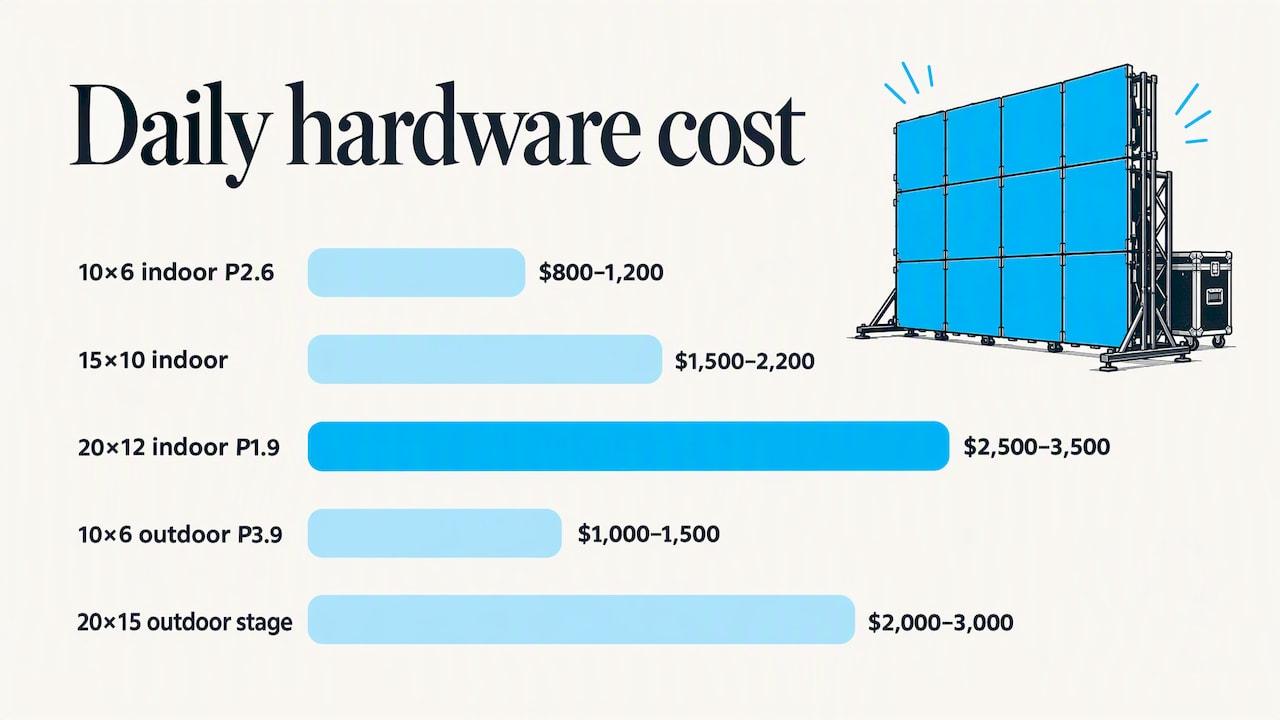
The most useful way to read a price is to start with the size of the wall and where it will stand. The figures below come from a mid-2026 US rental pricing table and show daily hardware ranges. I added the per-square-foot math so you can compare them with quotes quoted in other units.
| Wall setup | Daily hardware range | Approx. per square foot |
|---|---|---|
| 10 × 6 ft indoor, P2.6 | $800 to $1,200 | $13.33 to $20.00 |
| 15 × 10 ft indoor | $1,500 to $2,200 | $10.00 to $14.67 |
| 20 × 12 ft indoor, P1.9 | $2,500 to $3,500 | $10.42 to $14.58 |
| 10 × 6 ft outdoor, P3.9 | $1,000 to $1,500 | $16.67 to $25.00 |
| 20 × 15 ft outdoor stage backdrop | $2,000 to $3,000 | $6.67 to $10.00 |
Two patterns stand out. Larger walls cost less per square foot, because the fixed work of delivery, rigging and signal gets spread over more panels. Outdoor panels cost more per square foot at small sizes because they need higher brightness and weather protection.
The same source puts a technician at $500 to $800 per day and a mid-size event at $2,000 to $5,000 all-in. Treat these as a US benchmark, not a tariff. Rates in the New York and New Jersey area, in big hotel ballrooms or at union venues, can run higher, and any supplier can price differently from this table. Always ask for a written quote for your date, venue and hours.
A worked example
Say you book a 20 × 12 ft indoor wall at P1.9 for a corporate dinner with a stage presentation.
- Hardware: $2,500 to $3,500
- Technician for the day: $500 to $800
- Subtotal before delivery, power and tax: $3,000 to $4,300
At New Jersey’s 6.625% sales tax rate, tax on that subtotal alone would be roughly $199 to $285, if the whole amount is taxable. That’s before transport, rigging extras or overtime. Whether labor is taxed depends on how the invoice is structured, so check with your supplier and the state.
How rental pricing is calculated
Suppliers don’t all quote the same way. Some price per square foot per day, some per panel, others per square meter per week, and some give a flat package for the event. Rental guides note that you should convert everything to a single unit before comparing. The easiest unit for most US buyers is dollars per square foot per day, plus a separate line for labor.
To convert:
- Multiply the wall’s width by its height in feet to get square feet.
- Divide the daily hardware price by that number.
- Do the same for each quote, using the same pixel pitch and brightness.
If one quote is for 60 square feet and another for 100, the cheaper total may be the worse deal per square foot. And if one is hardware-only while the other includes a technician and delivery, you can’t compare them at all until you add the missing lines.
What drives the price up or down
Beyond raw size, a handful of factors decide where in the range you land.
Pixel pitch
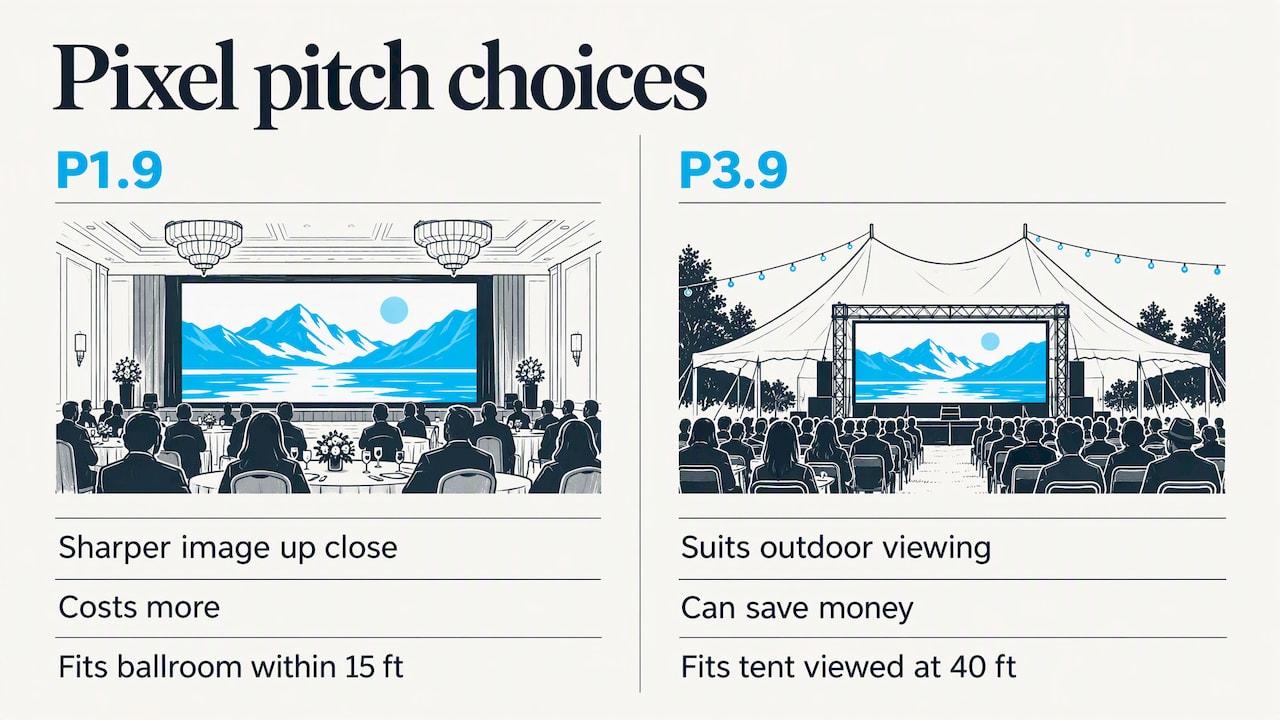
Pixel pitch is the distance between LEDs. A smaller number, such as P1.9, gives a sharper image for close viewing and costs more. A larger one, such as P3.9, suits outdoor use and longer viewing distances. For a ballroom where guests sit within 15 feet of the screen, a fine pitch matters. For a large tent seen from 40 feet away, you can often save money with a coarser one.
Indoor or outdoor
Outdoor walls need greater brightness, weatherproofing and often wind-rated rigging or ground support. Expect higher daily rates and more labor for the same square footage.
Labor and show operation
A wall that someone has to build, calibrate and run costs more than a plug-and-play display. Technician time is typically billed by the day or the hour. Long load-in windows, early morning setups and overnight standby can all add to the bill.
Rental length
First-day rates are the highest. Many suppliers discount extra days, which is why a two-day rental is rarely double the price of one. Ask how the second and third day are priced and whether the wall must stay on site overnight.
Venue rules
Some venues require certified riggers, insurance certificates, specific load-in times or freight elevator reservations. These can quietly add hundreds of dollars. Ask your venue coordinator before you collect quotes.
Content and playback
A wall is only as good as what plays on it. Slideshows, live camera feeds, logo loops and video mixes all need someone to prepare and run them. If you need custom motion graphics or a live camera mix, that’s a separate line from the screen itself.
What a complete quote should list
A hardware-only daily rate is not the same as the total event cost. Chipshow’s 2026 guide makes the same point and recommends comparing quotes on identical dimensions, pixel pitch, rental period and service scope. In practice, ask for these items to be itemized:
- Equipment hire (panels, processor, cabling)
- Installation and dismantling
- Transport and delivery
- Operation during the event
- Power and signal distribution
- Taxes and any non-refundable charges
- Any refundable deposit, kept separate from the cost
Anything missing from the list is either included without being mentioned or about to show up later as an extra. Ask which.
Sales tax on rentals
In New Jersey, the rental or lease of most tangible personal property is subject to the state’s sales tax, which is covered in the state’s leases and rentals tax bulletin. Other states have their own rules and local rates, so the tax line on a New York or Pennsylvania quote will differ. A quote that leaves tax out understates your real cost.
Costs by event type
The same wall doesn’t make sense for every event. Think about how the screen will be used, then size it to the job.
| Event | Typical use | What to budget for |
|---|---|---|
| Wedding | Monogram or photo slideshow behind the DJ, dance floor visuals | A smaller wall, often a custom backdrop to the booth, plus someone to run content |
| Sweet 16 or Quinceañera | Video tribute, live camera on the dance floor, visual effects | Mid-size wall and visuals synced with the DJ and lighting |
| Bar or Bat Mitzvah | Photo montage, party games, live camera | Mid-size wall with a content operator |
| Corporate event | Presentations, branding, live feed for large rooms | Larger wall, technician, signal switching and a rehearsal slot |
| Trade show or large stage | Brand wall, hybrid streaming | Large wall, long load-in, multi-day pricing |
For a wedding or family celebration, the screen is usually part of the entertainment design, not a standalone AV rental. That changes how you buy it. When the wall, the DJ booth, the lighting and the video content come from one team, there are fewer handoffs, less time lost at load-in and one person responsible when something needs adjusting. If you’re planning a business event, our guide to corporate event production costs covers what a full production budget includes beyond the screen.
Where the rest of the budget goes
A video wall is one line in a larger event budget. Food and beverage minimums often take the biggest share, and venues that host private parties publish their menus and packages, such as these private event menus from a New Jersey restaurant. Knowing that number first tells you how much is left for screens, lighting and entertainment, and it keeps you from choosing a 20-foot wall for a budget that suits a 10-foot one.
If you want the wall to show a live feed of your own event, you’ll also need camera coverage. Our photography and videography service covers that side, so the cameras, the content and the screen work as one system.
How to keep the cost down without losing impact
- Size to the room. Measure the viewing distance. Guests don’t need a 20-foot wall in a room where the farthest table is 30 feet away.
- Match the pitch to the distance. Pay for fine pixel pitch only when people will sit close.
- Book one load-in window. Rushed or split setups add labor hours.
- Use fewer days. Ask whether you can set up and run on the same day.
- Prepare content early. Final files delivered a week before the event cost far less to handle than changes at the venue.
- Ask for a total, not a rate. A single all-in number for your date and hours is the easiest to compare.
Perspective: why we build the wall into the event
After more than 25 years designing celebrations in New Jersey, New York and abroad, we’ve learned that an LED video wall succeeds or fails on planning, not on panel specs. A beautiful screen with weak content, or a wall that blocks sightlines, wastes the money spent on it.
That’s why our Custom LED Video Wall and LED TV screens are part of the event design, not an add-on dropped in at the end. We plan placement with the DJ booth, the lighting, the monograms and the flow of the room. When a wall frames the Piano DJ Booth or carries a couple’s monogram through the night, it looks intentional because it was designed that way.
We also run the content. Our DJs and MCs cue video tributes, slideshows and live camera moments to the music and the schedule, so nobody has to hunt for a technician in the middle of a toast. For clients who celebrate in more than one language or culture, our bilingual and international team shapes the moments the screen supports.
Our advice: ask every supplier for a total that includes the operator and the content plan. Then choose the team that can explain how the wall will be used from the first dance to the last song.
LJDJS
Plan your wall with LJDJS
If you’re weighing a video wall for a wedding, a milestone party or a corporate evening, we can design it together with your entertainment, lighting and photography, so you get one plan and one team. Our wall and screen options sit alongside intelligent lighting, wireless uplighting and monogram projection on our services page, and we tailor each package to your event. We don’t publish a price list, because the right setup depends on your room, guest count and style.
Tell us your date, venue and guest count through LJDJS, and we’ll talk through what size and setup suit your event. For weddings, see our wedding entertainment page. If you’re planning a LED-backed dance floor look for a milestone party, our Sweet 16 and Quinceañera and Bar and Bat Mitzvah pages show how those events come together.
FAQ
How much does it cost to rent an LED video wall for one day?
For indoor walls in the US, daily hardware pricing in one 2026 guide runs from $800 to $1,200 for a 10 × 6 ft wall up to $2,500 to $3,500 for a 20 × 12 ft wall. Technician time, delivery, power and tax come on top. Your actual quote depends on your market, venue and date.
Is LED wall rental priced per square foot or per panel?
Both are common, and some suppliers use per-day, per-week or flat event packages. Convert every quote to dollars per square foot per day, then add labor and delivery separately so you can compare them fairly.
Do I need a technician with the wall?
In most cases, yes. One US pricing table lists a technician at $500 to $800 per day. Someone has to set up, calibrate and run the screen, especially when it carries live video or timed content.
Is sales tax charged on LED wall rentals?
It depends on your state. New Jersey, for example, taxes the rental of most tangible personal property, as the state’s rentals bulletin explains. Ask your supplier whether tax is in the quote and check your own state’s rules.
Is a bigger wall always better for a wedding?
No. Size the screen to the room and the viewing distance. A smaller, well-placed wall behind the DJ booth, with strong content, often does more for a wedding than a large screen that crowds the dance floor.
Sources
- LED Wall Rental Guide: Real Costs, Quality Checks
- LED Screen Rental Price Guide: Costs and Tips
- LED Screen Rental Cost: Build a Like-for-Like Event Budget
- New Jersey Leases and Rentals Tax Topic Bulletin S&U-12
- Private Event Menus, Il Villaggio Restaurant and Bar
Pingback: Corporate Event Design: A Practical Guide for Planners – LJDJs Event Design & Entertainment