
Wedding day coordination means one person owns the timeline, the vendors and the small emergencies so you can be a guest at your own wedding. The timeline only works if the people carrying it out hear it at the right moment, and in a ballroom that is the DJ and MC. Our team plans entertainment and design with the whole day in mind, so the schedule your coordinator builds becomes the schedule your guests feel. Here is what coordination covers, what it costs, how to hand off your plans and where entertainment fits.
TL;DR
- A day-of coordinator runs a plan you have already built: vendor setup, timeline, ceremony cues and troubleshooting. A full-service planner helps build the plan from the start.
- Published 2026 US guides put day-of coordination at roughly $800 to $3,500, depending on city, guest count and scope.
- Prepare a vendor contact sheet, a minute-by-minute timeline and a handoff meeting about two weeks before the wedding.
- Your DJ and MC is the voice of the timeline: introductions, toasts, dances and cake cutting all depend on them.
- Read the contract, not the label. “Day-of” means only what the contract lists.
Table of Contents
- What wedding day coordination actually includes
- Day-of, month-of and full-service: the real differences
- What wedding coordination costs in the United States
- When coordination is worth it
- How to coordinate your wedding day step by step
- Where the DJ and MC fit in your coordination plan
- Choosing the right coordination support
- Planning your entertainment around the timeline
- Our perspective
- FAQ
- Sources
What wedding day coordination actually includes
A day-of coordinator is a logistics professional who takes over a plan you have already made. One venue describes the coordinator as the first to arrive and last to leave, handling vendor setup, the timeline from hair and makeup through the first dance, ceremony cueing, emergencies, décor setup and breakdown, and packing up gifts at night’s end.
On the day, that usually breaks down into four jobs:
- Arrival and load-in. One guide says the coordinator arrives two to four hours before the ceremony to direct vendor setup and run the ceremony lineup.
- Timeline enforcement. Photographers, caterers, florists and musicians all work from one schedule, and the coordinator keeps them on it.
- Cueing. Processional, speeches and transitions between ceremony, cocktail hour and reception are signaled by the coordinator.
- Quiet troubleshooting. A late shuttle, a missing boutonniere or a rain plan gets solved before you hear about it.
Amy Shack Egan of Cheersy calls coordinators a couple’s logistical superhero, on site from load-in to load-out so the couple can actually enjoy the event.
Day-of, month-of and full-service: the real differences
The three labels describe how early someone joins your planning.
| Service | When they join | What they do |
|---|---|---|
| Day-of coordination | Roughly 4 to 12 weeks out, depending on the provider | Review contracts, build the timeline, confirm logistics, run the rehearsal and the wedding day |
| Month-of coordination | About 4 to 8 weeks out | Same core work, with more handoff and vendor confirmation before the day |
| Full-service planning | From the first call | Budget, venue search, vendor recommendations, contract review, design direction, then the day itself |
Plan and Gather puts the difference simply: a full-service planner prevents problems from being built into the plan, while a day-of coordinator manages the problems that come out of a plan you already made.
The label matters less than the contract. Wedding Remedy’s checklist notes that a planner or coordinator is defined by the task list in the contract, so verify the start date, meeting caps, on-site hours, assistant count, rehearsal coverage and overtime rates. An eight-hour day that starts at noon may end before your reception does.
What wedding coordination costs in the United States
Prices vary by guide, so treat them as ranges for 2026 rather than quotes.
| Source (2026) | Day-of | Month-of | Full-service |
|---|---|---|---|
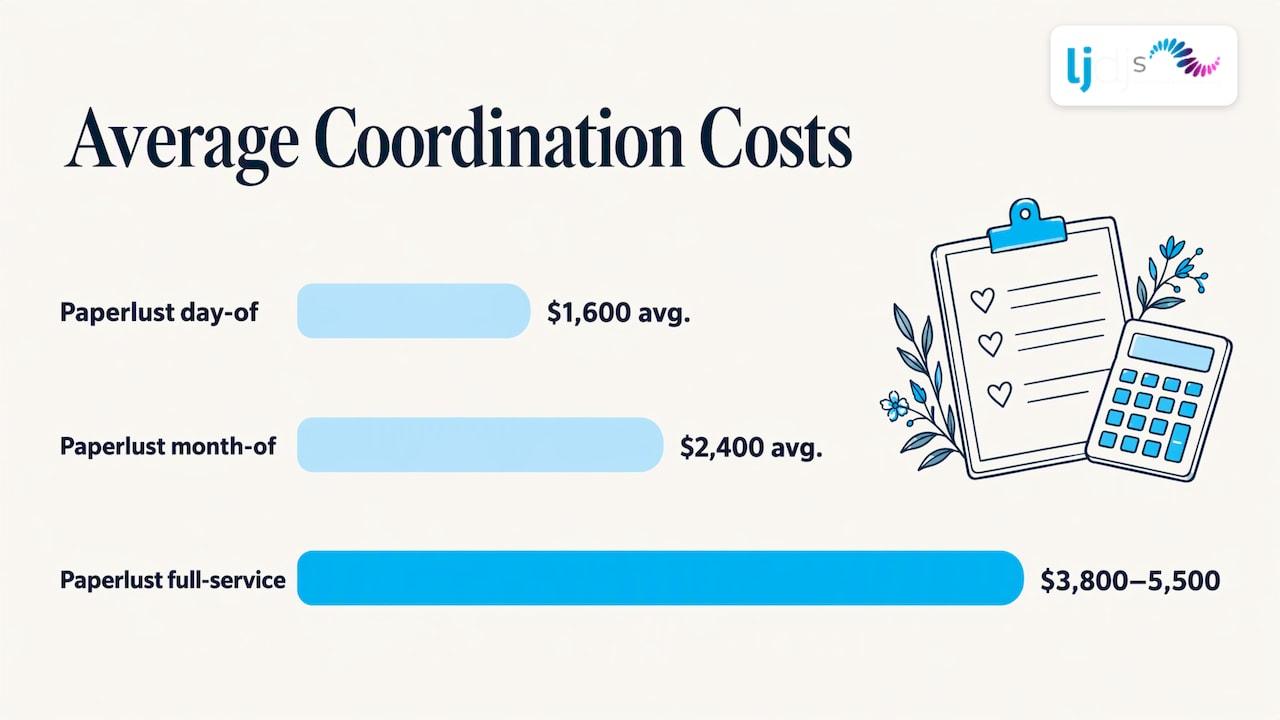
| Paperlust | $800 to $2,500 (average $1,600) | $1,500 to $4,000 (average $2,400) | Averages $3,800 to $5,500 |
| Joy | $800 to $3,500 (average about $1,800) | $1,500 to $4,000 (average about $2,400) | $3,500 to $15,000+ |
| Revel.cam | $800 to $1,800 (on-site only) | $1,800 to $4,500 | $3,500 to $7,500 (8 to 16+ weeks) |
What moves the price, according to Joy’s guide: a major metro location, a guest count over 200 (often 20 to 40% more), peak season from May to October, planner experience, and complexity such as multi-day, destination or unconventional-venue events. Most coordinators charge flat fees, though some bill hourly or as a percentage of the budget.
Add-ons can change the total. Revel.cam lists assistant coordinators at $300 to $1,200 or more and rehearsal management at $200 to $800 or more. Ask for the full price in writing before you sign.
When coordination is worth it
RSVP’d advises bringing in a coordinator if you planned the wedding yourself but want a professional on the logistics, or if the wedding has 100 or more guests, a complex or outdoor venue, cultural elements or complicated family dynamics. Small weddings under 50 guests at all-inclusive venues often need less.
Cultural elements deserve a word of their own. A wedding with a bilingual ceremony, a cocktail hour followed by a traditional dance set or a grand entrance with several family groups has more cues than a standard timeline. Every cue is another place for things to slip, which is why we plan entertainment around your family’s customs from the first conversation.
How to coordinate your wedding day step by step
Whether you hire a coordinator or hand the plan to a trusted friend, the preparation is the same. This is the routine, with the points where it usually goes wrong.
1. Build one master timeline
Write out every moment from hair and makeup to the last song. The Wedding Talk suggests covering vendor arrivals, ceremony and reception timing, hair and makeup start, first look, grand entrance and cake cutting. Where it goes wrong: couples schedule the ceremony and dinner carefully, then leave the reception blocks vague. Dances, toasts and the cake cutting each need a start time and a named person who introduces them.
This is where entertainment planning pays off early. Our team works from your timeline to set the order of introductions, dances and announcements, so the reception block is built with you, not improvised on the night. If you want to see how ceremony music is timed, our guide to wedding ceremony music order and timing walks through it.
2. Make a vendor contact sheet
List business names, contact persons, phone numbers, emails, arrival and departure times and special instructions for every vendor. The Wedding Talk recommends sharing digital copies of the template, contracts and floor plan. Signature Bride advises keeping all contracts in one shared folder, such as a Google Drive folder, so nobody is hunting for a PDF on the wedding morning.
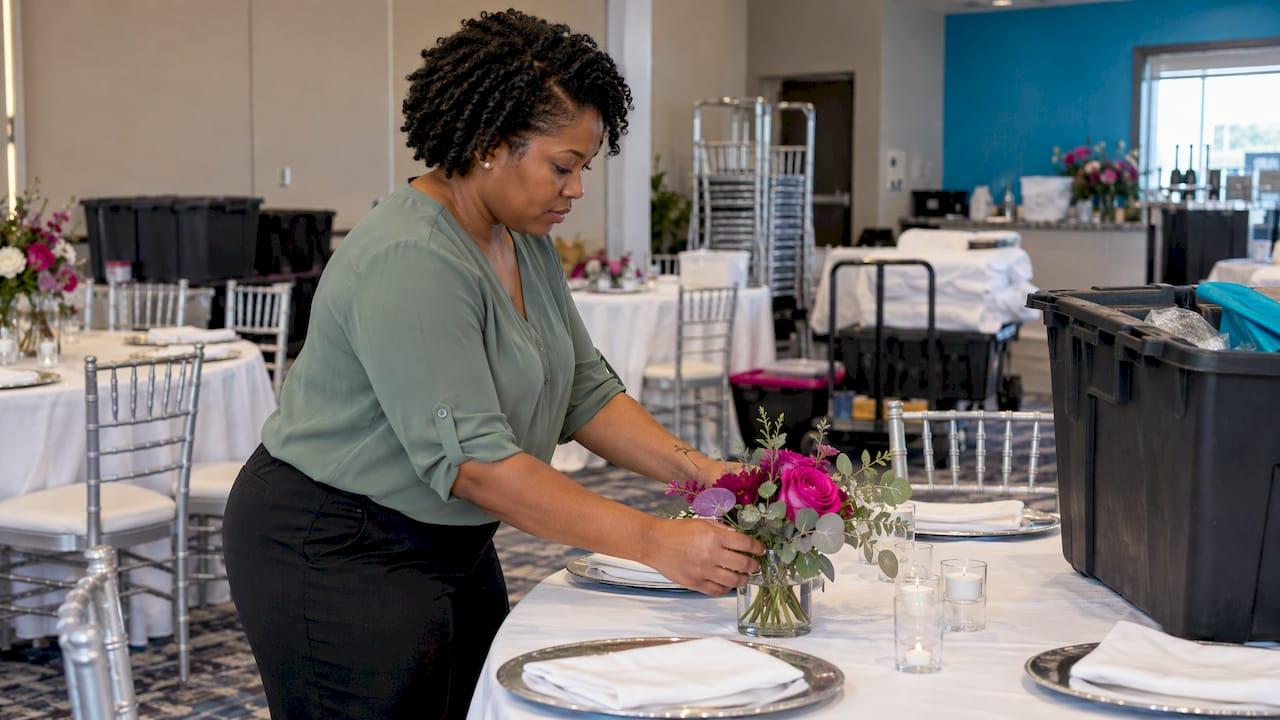
3. Label and pack the décor
Prep labeled bins with setup instructions so someone who was not at your planning meetings can place everything. A wedding décor checklist covering ceremony, reception and rentals helps you decide what is in each bin and who sets it up. Florals deserve the same care: confirming delivery windows and your date with the florist early prevents the most common morning surprises, and these questions to ask a florist before booking are a good place to start.
4. Schedule the handoff meeting
The Wedding Talk suggests a one to two hour meeting about two weeks before the wedding. Walk through the timeline, floor plan, family dynamics and any sensitive details. Candice Coppola’s coordinator checklist describes the same month-before work: confirming vendor details, finalizing a minute-by-minute timeline shared with vendors, wedding party and couple, and reviewing setup and breakdown logistics with the venue.
5. Confirm entertainment details in writing
Give your DJ and MC the pronunciations of names, the order of introductions, the song for each moment, any do-not-play list and who should be handed the microphone for toasts. This is the part of the timeline guests actually experience, so it deserves its own page in the handoff. Our wedding entertainment work starts with these details, and our bilingual and international DJs and MCs can present them in the languages your families speak.
6. Run the rehearsal
A rehearsal catches problems like blocked sightlines, a too-short processional song or a microphone that does not reach the altar. Walk the full lineup, including who cues whom.
7. Plan the last hour
Decide who packs gifts, cards and personal items, who handles vendor tipping envelopes and who stays until load-out. If nobody is named, it falls to you.
Where the DJ and MC fit in your coordination plan
The coordinator controls the schedule behind the scenes. The MC controls it in front of the guests. When the two are in step, the grand entrance, first dance, toasts, dinner service, cake cutting and last song happen on cue, and nobody has to wave at a bandleader from across the room.
A few practical ways to line them up:
- Share one timeline. The coordinator, the DJ and MC and the photographer and videographer should each hold the same version.
- Agree on cue signals. Decide whether the coordinator gives a nod, a text or a radio call before each announcement.
- Give the MC a quiet backup plan. If dinner service runs ten minutes long, the MC and coordinator should already know which segment shrinks.
- Plan the visual moments too. Lighting changes, a monogram projection or an LED video wall slideshow are all cues. Our guide to wedding gobo lighting and monogram placement shows what to settle before the day.
For New Jersey couples, our page on choosing a New Jersey wedding DJ covers what services to expect, and our breakdown of what couples really pay for a wedding DJ helps you fit entertainment into the same budget as coordination.
Choosing the right coordination support
Before signing with anyone, use these questions drawn from the research.
- What service level do you offer? Brides.com advises asking whether the planner offers month-of, partial or full planning, since that sets expectations from the start.
- Do you work for the venue or independently? RSVP’d flags a “coordinator” who is really a venue sales role as a red flag, along with one who starts less than four weeks before the wedding or does not ask for your timeline, vendor list and contracts in the first meeting.
- Who are your past clients? Ask for references, photos and their role at those weddings, plus whether they have worked with your vendors.
- What does the contract say? It should name hours, services, cancellation terms, a force majeure clause and backup coverage if the coordinator cannot attend.
- When should I book? Tulle Together advises booking day-of coordinators four to six months ahead and month-of coordinators six to nine months ahead, because popular ones fill early.
There is no single right answer. Plan and Gather’s Callan Wood says neither role is inherently better, since they solve different problems. Many couples combine tools: a planning platform for day-to-day tracking and a professional for execution.
Planning your entertainment around the timeline
We design the entertainment side of your day so it fits inside your coordination plan, not beside it. For weddings that means an experienced DJ and MC, with bilingual and international options, plus enhancements such as our Piano DJ Booth and Chandelier DJ Booth, LED video walls, intelligent and wireless lighting, monogram projection, in-house photography and videography, photo booths, live musicians and specialty acts.
If you are building your timeline now, start with our wedding entertainment page and tell us your venue, guest count and the moments that matter most to your families. We tailor the plan to your style and culture, then carry it through to the last song.

We serve couples in New Jersey and New York and work internationally. Visit LJDJS to start the conversation.
Our perspective
A wedding day is a chain of handoffs. The coordinator hands the ceremony to the officiant, the officiant hands the room to the cocktail hour, and the cocktail hour hands it to us. After 25 years in this business, we believe the reception is where a well-built timeline either shows or falls apart, because that is where every guest is watching and listening at once.
That is why we do not treat entertainment as a playlist. We treat it as part of the day’s design: the order of introductions, the language of the announcements, the lighting that changes with each moment, the booth that frames the first dance. Our bilingual and international DJs and MCs are there so both sides of a family feel included, and our enhancements, from the Piano DJ Booth to LED video walls, are built to land on cue.
Our advice is to bring your DJ and MC into the plan early, hand them the same timeline as everyone else and decide who gives each cue. When the whole team works from one page, the couple stops managing and starts celebrating.
LJDJS
FAQ
What is the difference between a day-of coordinator and a wedding planner?
A wedding planner joins at the start and helps with budget, venue, vendors and design. A day-of coordinator joins later, typically weeks before the wedding, and runs a plan you have already built. The contract defines the real scope, so check what each one lists.
How much does a day-of wedding coordinator cost?
Published 2026 guides range from about $800 to $3,500, with averages between roughly $1,600 and $1,800. City, season, guest count and the number of included meetings all affect the price. Ask for hours, rehearsal coverage and overtime rates in writing.
When should I book day-of coordination?
Tulle Together suggests four to six months before the wedding to secure availability, and six to nine months for month-of coordinators. Popular coordinators book out quickly, especially in peak season from May to October.
Who tells the DJ when to start each moment?
Usually the coordinator cues the DJ and MC, either in person or by text or radio, based on one shared timeline. Agree on the signal at the handoff meeting and rehearse it if the schedule is tight.
Do I still need a coordinator if my venue has one?
A venue coordinator often focuses on the venue’s own staff and spaces. Ask whether yours also manages outside vendors, your ceremony lineup and your timeline, and confirm it in writing. RSVP’d notes small weddings at all-inclusive venues with a dedicated banquet coordinator may need less outside help.
Sources
- What Does a Day of Wedding Coordinator Do? Historic Acres of Hershey
- Coordinator, Planner, or Platform: Which Do You Need? RSVP’d
- The Ultimate Guide to Hiring a Day-of Coordinator for Your Wedding, Signature Bride
- Full-Service Wedding Planner vs. Day-of Coordinator, Plan and Gather
- What should a wedding planner contract include? Wedding Remedy
- How Much Does a Wedding Planner Cost? (2026 Guide), Paperlust
- How Much Does a Wedding Planner Cost in 2026? Joy
- Wedding Coordinator Cost in 2026, Revel.cam
- How to Seamlessly Hand Off Your Wedding Plans to a Day-of Coordinator, The Wedding Talk
- The Ultimate Checklist for Wedding Coordinators, Candice Coppola
- 35 Questions to Ask Before Hiring a Wedding Planner, Brides.com
- Do You Need a Wedding Planner? Tulle Together
Pingback: Wedding Production Services: What They Include in 2026 – LJDJs Event Design & Entertainment